

What to Do If Someone Is Having a Heart Attack in Public
Estimated reading time: 7 minutes
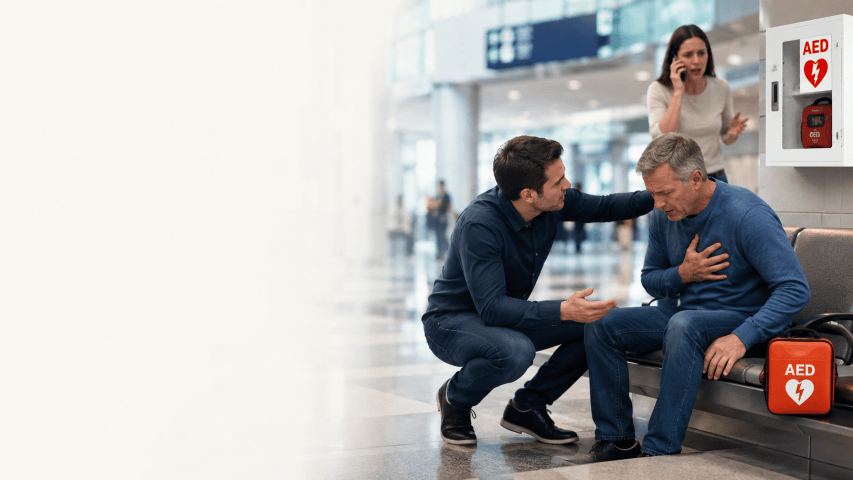
A crowded restaurant, grocery store, workplace, airport, church, or sporting event may be the last place you expect a medical emergency. But heart attacks can happen anywhere, and knowing what to do during those first few minutes can make an enormous difference.
If someone develops symptoms that could indicate a heart attack, don’t wait to see if they get better. Call 911.
Even if you’re unsure whether it’s actually a heart attack, getting emergency medical help quickly is the safest choice.
Know the Warning Signs of a Heart Attack
Heart attack symptoms aren’t always dramatic. A person doesn’t necessarily collapse while clutching their chest.
Common warning signs can include:
- Pressure, squeezing, fullness, discomfort, or pain in the chest
- Pain or discomfort in one or both arms
- Pain in the back, neck, jaw, shoulder, or stomach
- Shortness of breath
- Cold sweat
- Nausea or vomiting
- Lightheadedness or dizziness
- Unusual weakness or fatigue
Symptoms can vary from person to person. Women may be more likely to experience symptoms such as nausea, shortness of breath, back or shoulder pain, unusual tiredness, or weakness in addition to chest discomfort.
The important thing is not to dismiss suspicious symptoms simply because they don’t look like the classic movie version of a heart attack.
1. Call 911 Immediately
If you suspect a heart attack, activate emergency medical services right away.
Don’t have the person drive themselves to the hospital, and don’t waste valuable time trying to decide whether the symptoms are serious enough.
Calling 911 gets trained medical professionals moving toward the patient. EMS personnel can begin evaluation and treatment before reaching the hospital and may be able to alert the hospital that a possible heart attack patient is arriving.
If you’re in a large public place, give the dispatcher a precise location. Include the business or venue name, entrance, floor, room, or nearby landmark when appropriate.
If several people are nearby, assign specific jobs:
“You call 911.”
“You get the AED.”
“You meet the ambulance at the entrance.”
Clear instructions help turn a crowd of spectators into a team.
2. Have the Person Stop and Rest
Keep the person calm and avoid unnecessary physical activity.
Have them sit or rest in a comfortable position while waiting for EMS. Don’t have them walk across a parking lot, attempt to drive home, or continue whatever activity they were doing.
If they’re in immediate danger, such as standing in traffic or another hazardous location, move them only as necessary to reach safety.
3. Consider Aspirin When Appropriate
According to American Heart Association and American Red Cross first aid guidance, while waiting for EMS, a first aid provider may encourage an alert adult experiencing nontraumatic chest pain to chew and swallow 162–325 mg of aspirin.
Do not encourage aspirin if the person:
- Is allergic to aspirin
- Has been told by a healthcare professional not to take aspirin
- Has another known reason aspirin may be unsafe
If you’re unsure whether aspirin is appropriate, it is reasonable to wait for EMS and follow the 911 dispatcher’s instructions.
Aspirin is not a substitute for calling 911.
4. Help With Their Prescribed Medication
Some people with known heart disease may carry prescribed nitroglycerin or other medication for chest pain.
If the medication belongs to that person, you can assist them in taking it according to their prescription or medical instructions.
Don’t give someone another person’s prescription medication.
5. Find an AED Before You Need It
If you’re in a public building, ask someone to locate the nearest automated external defibrillator, or AED.
You may see AEDs in places such as:
- Airports
- Schools
- Gyms
- Churches
- Shopping centers
- Government buildings
- Sports facilities
- Large workplaces
A person who is awake and experiencing heart attack symptoms does not need an AED shock.
However, a heart attack can sometimes trigger sudden cardiac arrest. Having the AED nearby means it can be used immediately if the person collapses and becomes unresponsive.
Heart Attack vs. Cardiac Arrest: They’re Not the Same Thing
This distinction is extremely important.
A heart attack is primarily a circulation problem. Blood flow to part of the heart muscle becomes blocked. The person is often awake and breathing.
Cardiac arrest is an electrical problem. The heart suddenly stops pumping blood effectively. The person becomes unresponsive and is not breathing normally.
A person having a heart attack can deteriorate into cardiac arrest, which is why someone should stay with them while waiting for EMS.
If the Person Suddenly Collapses
If the person becomes unresponsive and is not breathing normally or is only gasping, treat the situation as cardiac arrest.
Call 911 and Start CPR
If someone hasn’t already called 911, call immediately or send someone else to call.
Begin chest compressions in the center of the chest.
For an adult:
- Push hard and fast
- Compress at a rate of 100 to 120 times per minute
- Push at least 2 inches deep
- Allow the chest to fully recoil between compressions
- Minimize interruptions
For members of the public who aren’t trained in conventional CPR, Hands-Only CPR can be used for a teen or adult who suddenly collapses:
Call 911 and push hard and fast in the center of the chest.
Someone trained in CPR can provide conventional CPR using cycles of 30 chest compressions followed by 2 breaths.
Use the AED as Soon as It Arrives
Turn the AED on and follow its voice or visual instructions.
AEDs are designed to analyze the person’s heart rhythm and determine whether a shock is needed. You don’t have to decide whether to shock the person. The AED does that for you.
After a shock, or if the AED advises that no shock is needed, immediately resume CPR when instructed.
Continue CPR and follow the AED prompts until:
- The person begins showing clear signs of life
- EMS takes over
- You become physically unable to continue
- The scene becomes unsafe
Don’t Be Fooled by Gasping
One particularly dangerous mistake is assuming someone is breathing normally because they’re making occasional gasping, snorting, or unusual breathing sounds.
These agonal gasps can occur during cardiac arrest and are not normal breathing.
If someone suddenly collapses, is unresponsive, and is not breathing normally, call 911, begin CPR, and use an AED as quickly as possible.
What NOT to Do During a Suspected Heart Attack
Avoid several common mistakes:
- Don’t wait for the symptoms to become severe before calling 911.
- Don’t let the person drive themselves to the hospital.
- Don’t encourage them to “walk it off.”
- Don’t give them food or unnecessary drinks.
- Don’t give prescription medication that belongs to someone else.
- Don’t perform CPR on an awake person who is breathing normally.
- Don’t use an AED on a conscious person simply because they’re experiencing chest pain.
- Don’t assume gasping after collapse means they’re breathing normally.
- Don’t rely on so-called “cough CPR” instead of calling 911.
The goal is simple: recognize the emergency, activate EMS quickly, and be prepared if the person’s condition worsens.
CPR Training Makes Emergencies Less Intimidating
Reading about CPR is helpful. Practicing it is much better.
Hands-on CPR training gives you the opportunity to practice chest compressions, AED use, rescue breathing, choking response, and other lifesaving skills before you’re standing in the middle of a real emergency.
At In-Pulse CPR, our American Heart Association CPR classes provide hands-on training for healthcare professionals, workplace responders, teachers, caregivers, parents, and members of the community.
Knowing CPR doesn’t mean you’ll ever have to use it.
But if someone collapses in front of you someday, knowing what to do can turn you from a witness into a rescuer.
Find an upcoming In-Pulse CPR class near you and learn the skills that can help save a life.
Quick Summary
If someone may be having a heart attack:
- Call 911 immediately.
- Have the person stop activity and rest.
- Consider 162–325 mg of chewable aspirin when appropriate.
- Help with their own prescribed chest-pain medication, if applicable.
- Have someone bring an AED nearby.
- Stay with the person and watch for changes.
- If they become unresponsive and aren’t breathing normally, start CPR immediately.
- Use the AED as soon as possible and follow its instructions.
When it comes to a heart attack or cardiac arrest, minutes matter. Knowing what to do before an emergency happens may someday help you save someone’s life.