

Florida’s Life-Saving Requirement: CPR Training in Public High Schools
Do Florida high school students need CPR training to graduate?
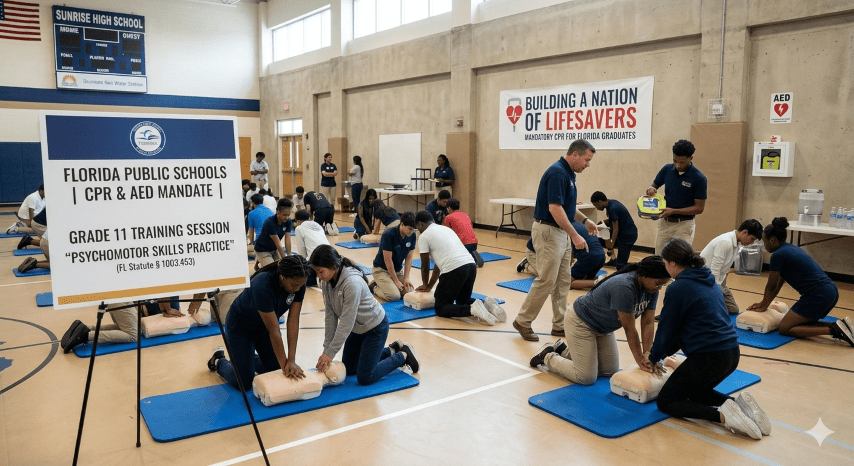
Yes. Under Florida Statute §1003.453, students must receive CPR, AED, and first aid training during high school, typically in 9th and 11th grade. This includes hands-on practice. However, most schools do not provide an official certification card required for many jobs.
12th Grade Floridians need CPR certification for the real world
Many seniors (12th graders) realize in August that they need a formal CPR card for internships, work-study programs, or part-time jobs in daycare or gyms.
The New Standard for Florida Students
For years, safety advocates pushed for something simple that could save lives: teach CPR in schools. Florida made that vision real.
Today, students graduate with more than a diploma. They leave with the ability to step into a crisis and do something that matters.
Under Florida Statute §1003.453:
- 9th and 11th Grade Training: Students receive CPR, AED, and first aid instruction twice during high school
- Hands-On Learning Required: Schools must include physical practice, not just watching videos
- Early Exposure Encouraged: Some districts introduce CPR as early as middle school
These programs are often aligned with guidance from the Florida Department of Education and national standards from the American Heart Association.
Why This Law Matters
Cardiac arrest can happen anywhere—on a field, in a classroom, at home.
Each year, hundreds of thousands of people in the U.S. experience cardiac arrest outside of a hospital. When CPR is started immediately, survival rates can double or even triple.
Florida’s approach is simple but powerful:
Train students early. Repeat the training. Normalize action.
Over time, that creates something bigger—a community where more people are ready to respond instead of hesitate.
School CPR Training vs. Professional Certification
While school programs meet the graduation requirement, they are not the same as a full certification.
| Feature | School Training | AHA Certification |
|---|---|---|
| Meets graduation requirement | ✔ Yes | ✔ Yes |
| Hands-on practice | ✔ Basic | ✔ Advanced |
| Certification card | ❌ Usually no | ✔ Yes (2-year eCard) |
| Accepted for jobs | ❌ Not always | ✔ Yes |
| Depth of training | Intro level | Real-world ready |
Beyond the Classroom: Why Certification Still Matters
For many students, school CPR training is the first step—not the final one.
A full certification becomes important when:
- Applying for summer jobs (lifeguarding, camps, childcare)
- Entering healthcare or nursing programs
- Working in fitness, coaching, or public-facing roles
- Wanting real confidence in an emergency situation
Professional training goes deeper. It uses real scenarios, higher-quality manikins, and reinforces muscle memory so actions feel natural under pressure.
How Long Do CPR Skills Last?
CPR is not just knowledge—it’s physical.
Without practice:
- Confidence drops within a few months
- Compression depth and rhythm become less accurate
That’s why professional certifications are valid for two years and emphasize hands-on repetition. It’s not about checking a box. It’s about being ready when it counts.
FAQ: CPR Requirements in Florida Schools
Is CPR training required to graduate in Florida?
Yes. Students must receive CPR, AED, and first aid instruction during high school.
Do schools provide a certification card?
Usually not. Most programs meet educational requirements but do not issue an official certification accepted for employment.
Why is hands-on training required?
Because CPR is a physical skill. Practicing compressions improves confidence and increases the likelihood someone will act in a real emergency.
Do Florida schools teach full CPR certification?
Typically, they teach basic CPR and AED awareness, not full professional certification.
Is CPR training required every year?
No. It is generally required twice—once in 9th grade and again in 11th grade.
Where to Get Certified in Florida
If you need a formal 2-year certification for work, school, or personal readiness, a professional course is the next step.
Our Florida training sites offer:
- 100% in-person, hands-on instruction
- American Heart Association certification cards
- Real-world scenario training
- A certification guarantee so you leave fully prepared
Florida Locations We Serve
We offer CPR training across Florida, including:
Tampa • Orlando • Fort Myers • Ocala • Lakeland • Westshore • Citrus Park
Final Thought
Florida’s CPR requirement is a quiet revolution.
Every year, thousands of students walk across a stage carrying more than a diploma—they carry a skill that can stop a moment from becoming a tragedy.
And sometimes, that skill is the difference between standing by… and stepping in.
