

A Life-Saving Call: When Every Second Counts
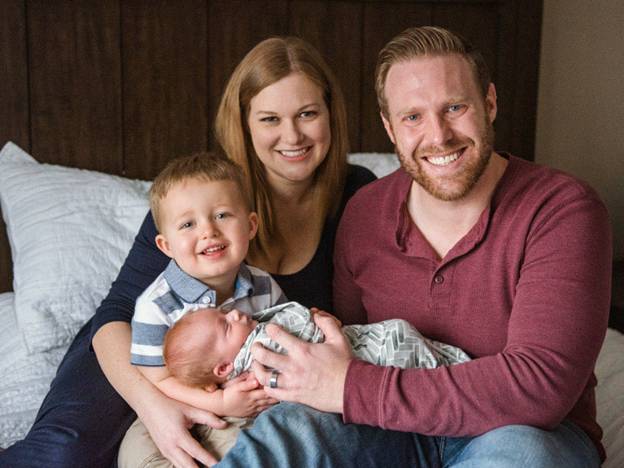
The Schammert family (clockwise from top left): Kym, Bill, and sons Cameron and Theo. (Photo – Emily Hardy Photography)
First Reported April 2021
The moment that would change everything started with something as simple as the sniffles. For Bill and Kym Schammert, what began as a routine precautionary visit to their pediatrician became a parent’s worst nightmare—and ultimately, a testament to the power of staying calm under pressure.
Their newborn son Cameron, just 13 days old, had developed what seemed like a minor cold. Better safe than sorry, they thought, as they prepared to take him to the doctor. But as Bill secured Cameron in his car seat, something went terribly wrong.
“He was as purple as purple can be,” Bill would later recall, his voice heavy with the memory.
The infant was gasping, struggling for air that wouldn’t come. Panic set in as Kym quickly lifted Cameron from his seat while Bill’s fingers found his phone, dialing the three numbers that connect us to help when we need it most: 911.
On the other end of the line, dispatcher Lisa Pachunka’s voice cut through their terror with steady professionalism. She ran through her checklist—was the baby choking? Was there an obstruction? But the answers painted a frightening picture: Cameron was limp, unresponsive, his tiny body fighting a battle he was losing.
“I was hoping I’d hear his baby cry after a few seconds,” Pachunka later admitted. “But that wasn’t the case.”
When it became clear that Cameron needed CPR, Pachunka faced a common but critical situation. The parents had learned the technique three years earlier during prenatal classes for their first son, Theo, but in this moment of crisis, their minds had gone blank. Fear has a way of erasing everything we think we know.
So Pachunka became their lifeline, her voice streaming through the phone’s speaker as she guided them step by step. She explained the precise technique for giving CPR to an infant: two fingers positioned in the center of the chest, about half an inch below the nipples. She reminded them to cover Cameron’s entire nose and mouth when giving rescue breaths.
Kym took the first shift, alternating 30 chest compressions with two rescue breaths, then Bill stepped in for his turn. Through it all, Pachunka’s voice remained their anchor.
“During the most stressful moment of our lives, she was one of the calmest voices I’d ever heard,” Bill said.
Then, like the most beautiful sound they’d ever heard, Cameron cried. Color returned to his skin. Life returned to their world. Paramedics arrived moments later, rushing mother and baby to the hospital while Bill followed behind, his hands likely trembling on the steering wheel.
At the hospital, doctors ran test after test—flu, COVID-19, various viral infections—but everything came back negative. A chest X-ray revealed the culprit: congested lungs that required treatment at the specialized children’s hospital in Omaha.
The transfer separated the family due to COVID-19 protocols. For two and a half hours, Bill and Kym waited, not knowing if their son was okay. “That was one of the harder moments,” Bill said, a masterpiece of understatement.
But when they arrived at the children’s hospital, they found Cameron’s condition stabilizing. By the next morning, the sniffles were gone, his oxygen levels normal. Doctors believed a mucus plug had blocked his airway—something his tiny body couldn’t clear on its own, but something that CPR had helped dislodge.
“We were surrounded by heroes and the best possible outcome happened,” Bill reflected.
The Schammerts knew exactly who their hero was. Bill arranged to meet Pachunka in person, a gesture that moved the veteran dispatcher deeply. She had never met a caller face-to-face before, but this case had touched her heart.
“As much as he says I’m a hero, he should get the credit for being such a great dad in that situation,” Pachunka said, deflecting praise with the humility common among those who save lives as part of their daily work.
When Bill returned to his job as a TV news anchor, he used his platform to share their story. Beyond thanking Pachunka, the first responders, and medical staff, he had a larger message: CPR training isn’t just useful—it’s essential.
“These skills aren’t hard to pick up,” he told his viewers, “and they could save a life.”
In Cameron’s case, those skills saved everything that matters. Today, he’s a healthy, thriving child, living proof that sometimes the difference between tragedy and triumph is as simple as knowing what to do when every second counts—and having someone calm enough to guide you through it when your world is falling apart.
The Schammerts’ story reminds us that heroes come in many forms: the dispatcher who stays calm in chaos, the parents who perform CPR with shaking hands, the medical professionals who provide expert care. But perhaps most importantly, it reminds us that any of us can be that hero—if we’re prepared.
