

A Second Chance: Mary’s Journey from Cardiac Arrest to Recovery
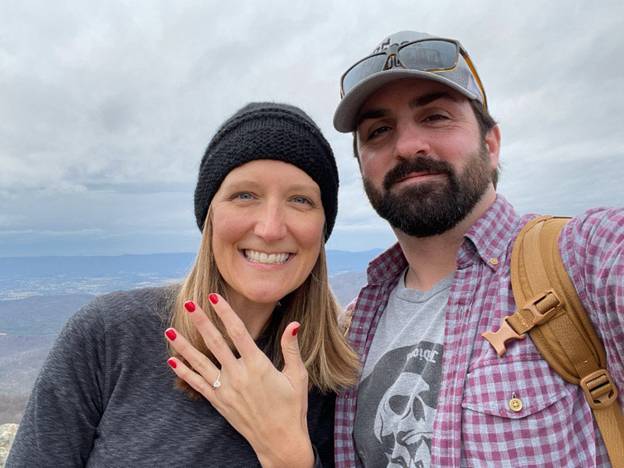
Cardiac arrest survivor Mary Gordon (left) with her fiancé, Matt Costakis. (Photo from Mary Gordon)
First Reported August 2021
Mary Gordon had always been the picture of health. At 37, she was the kind of person who conquered 5K races and powered through intense cycling sessions without breaking stride. Her body was her ally, reliable and strong—until the day it wasn’t.
The warning signs began subtly, creeping in just before Christmas 2019. What started as unusual tiredness after an ugly sweater party quickly escalated into something far more sinister. While hanging holiday decorations, Mary found herself stopping repeatedly, her energy mysteriously depleted. During a shopping trip to Washington, D.C., the world briefly went black around her.
“Everything went blank,” Mary remembered. “But it happened so fast I almost convinced myself it was nothing.”
But her body had other plans. Over the following week, near-fainting episodes became a terrifying pattern, striking three more times—including once while she was behind the wheel of her car.
Concerned enough to squeeze in a last-minute appointment on New Year’s Eve, Mary arrived at her doctor’s office feeling so drained she half-expected to be hospitalized immediately. Something deep inside told her to update her account beneficiaries before the visit—a premonition that would prove eerily prescient.
The physician assistant’s examination revealed a troubling contradiction: Mary’s heart rhythm appeared normal, but her blood pressure was dangerously elevated. A heart monitor was prescribed to gather more data, and her upcoming flight was cancelled.
The monitor wasn’t entirely foreign to Mary. Years earlier, doctors had diagnosed her with mitral valve prolapse after detecting a heart murmur during college. The condition, where excess tissue in the heart valve’s leaflets causes them to bulge into the left atrium, had been deemed minor—”a two out of ten, nothing to worry about,” her doctor had assured her.
But as Mary left that New Year’s Eve appointment, her body delivered its most devastating message yet.
Near the elevator, she collapsed.
A receptionist heard her labored breathing and discovered her unconscious. Mary Gordon was in cardiac arrest.
For six critical minutes, the physician assistant and a doctor performed CPR, using an automated external defibrillator to shock her heart back to life. The second shock brought her back—though her first memory wasn’t of awakening, but of being in the emergency room, surrounded by her boyfriend Matt Costakis and a team of medical professionals.
“My brain wasn’t retaining information,” Mary recalled of those first confusing days. “Everything existed in a fog until reality finally started to sink in.”
The road to recovery required immediate intervention. Two days later, surgeons implanted a cardioverter defibrillator in Mary’s chest. A week after that, a minimally invasive procedure repaired her mitral valve.
It was only during surgery that doctors discovered the true culprit behind Mary’s cardiac arrest: mitral annular disjunction, a particularly rare condition that makes significant valve prolapse and dangerous arrhythmias more likely.
“That variant is the most prone to significant prolapse and may be more closely associated with the kind of arrhythmia she presented with,” explained Dr. Paula Pinell-Salles, Mary’s cardiologist at Virginia Heart in Falls Church.
After two weeks in the hospital, Mary returned home, eager to reclaim her life through cardiac rehabilitation. The structured program offered exactly what she needed—a safe environment to rebuild her strength, stamina, and confidence alongside other survivors who understood her journey.
“The idea of raising my heart rate or running again seemed impossible,” Mary reflected. “Having medical professionals monitor my progress made all the difference in believing I could get back to who I was.”
When COVID-19 shut down in-person rehabilitation, Mary adapted, taking long walks with her dog Almond. Still, exercising alone carried emotional weight. She now wore an emergency ID tag—a tangible reminder of how quickly everything could change.
“It was a weird transition and very emotional,” she admitted. “But eventually, I reached the point where I could venture out by myself again.”
Eight months after her cardiac arrest, Mary achieved a milestone she’d once thought impossible: she started running again.
One year to the day after her brush with death, Mary planned a celebration. She, Matt, and Almond would hike her favorite trail at Shenandoah National Park—a challenging three-mile climb to a mountain summit.
Despite cold, rainy conditions, they reached the top. As Mary sat on a large rock, searching her backpack for dog treats, Matt reached into his pocket for a different kind of surprise: a diamond engagement ring.
“I made it so easy for him with that romantic mountaintop setting,” Mary laughed. “I had to ask him several times if it was real before I finally said yes.”
Now engaged and largely recovered, Mary has found new purpose in education and advocacy. She’s passionate about helping others understand the crucial difference between heart attacks—caused by blockages—and cardiac arrest, which stems from electrical problems and can strike anyone, regardless of apparent health.
This mission has made her a tireless advocate for CPR training, skills that saved her life that New Year’s Eve. She’s already planning training sessions for family and friends, determined to ensure others have the knowledge that could make the difference between life and death.
Mary’s story serves as a powerful reminder that health can change in an instant, but with proper medical care, determination, and the support of loved ones, it’s possible to not just survive—but to thrive.
