

Pennsylvania’s New School AED Law: What Schools Need to Know About CPR Training, AEDs, and Cardiac Emergency Plans
Sudden cardiac arrest (SCA) can strike without warning. It does not discriminate between a healthy student-athlete on the field, a teacher in the hallway, or a parent in the bleachers.
According to the American Heart Association, thousands of children under the age of 18 experience cardiac arrest outside of a hospital each year in the U.S., and a significant percentage of those cases are sports-related. In those terrifying moments, the first few minutes matter most. Immediate access to an Automated External Defibrillator (AED) and a trained bystander can turn a heartbreaking emergency into a survivable event.
In fact, schools equipped with AEDs see youth survival rates climb dramatically compared to the national average.
To make emergency responses more organized, practiced, and consistent across the Commonwealth, Pennsylvania has enacted a major legislative update. Known as Greg Moyer’s Law, this new statute helps ensure that schools are no longer just reacting to emergencies, but actively preparing for them.
What Is Greg Moyer’s Law?
On May 13, 2026, Governor Josh Shapiro signed Senate Bill 375 into law as Act 17 of 2026. Officially designated as Greg Moyer’s Law, the legislation honors 15-year-old Greg Moyer, a Notre Dame Jr./Sr. High School student who tragically died from sudden cardiac arrest during a high school basketball game in 2000.
Act 17 updates the Pennsylvania Public School Code by establishing clear statewide safety standards for:
- CPR and AED instruction availability
- AED access during school hours and athletic activities
- Trained personnel presence in school buildings
- Cardiac Emergency Response Plans (CERPs)
- Annual AED inventory and readiness reporting
Who Is Affected?
The law applies broadly across Pennsylvania’s educational landscape. The following entities must comply with the new requirements:
- Public school districts
- Charter schools, regional charter schools, and cyber charter schools
- Intermediate units (IUs)
- Area career and technical schools
- Nonpublic schools, including private and parochial schools
While some components apply to basic school-day operations, other requirements specifically apply to schools that participate in interscholastic athletics.
CPR and AED Training Requirements
Act 17 ensures that school staff have access to life-saving instruction. Under the law, schools must make CPR and AED instruction available to employees and approved volunteers at least once every two years.
For general employees and volunteers, the law focuses on making instruction available. Certain roles, however, have specific training and certification requirements.
Instruction may be provided by recognized certifying agencies, including:
- The American Heart Association (AHA)
- The American Red Cross
- The National Safety Council
- Other approved certifying organizations
Schools are also required to maintain documentation of completed training sessions and active certifications.
Practical Takeaway: Do not wait until the compliance deadline approaches to train your staff. Schools should begin mapping out a rolling, two-year training calendar now to prevent administrative bottlenecks, missed renewals, and scheduling conflicts.
Who Must Be Trained?
The law specifically identifies certain frontline staff members who must hold active CPR and AED certifications. These individuals are often closest to students during periods of physical activity or school-day medical emergencies.
Mandatory training applies to:
- School nurses, or their official designees
- Athletic coaches
- Athletic trainers
- Physical education teachers
- Marching band directors
These roles matter because cardiac emergencies often happen where students are active: gyms, fields, practices, games, marching band events, and physical education classes.
CPR & AED Training for Pennsylvania Schools
In-Pulse CPR has provided CPR and AED training for schools and educational organizations across Pennsylvania, including Central Dauphin Middle School in Harrisburg, Copeland Run Academy in Downingtown, Infinity Charter School in Harrisburg, Joyful Noise in York, Lititz Area Mennonite School in Lititz, Messiah University in Mechanicsburg, The Silver Academy in Harrisburg and others. For schools reviewing their AED readiness under Pennsylvania’s new requirements, we can help train nurses, coaches, teachers, athletic staff, office teams, support staff, and student groups through hands-on American Heart Association CPR and AED classes. Learn more about onsite CPR and AED training. |
Trained Responders Must Be Present During the School Day
Having life-saving equipment is only part of the equation. Schools also need people on-site who know how to respond.
Act 17 requires that at least one CPR and AED-trained individual be present in each school building during each school day.
The law defines the “school day” as the hours when children subject to compulsory attendance are expected to receive instruction. This means school administrators need to think carefully about staffing logistics, employee absences, substitute coverage, and multiple-building campuses.
Practical Checklist for Administrators
[ ] Identify and Audit: Map out every distinct school building owned or leased by your school entity.
[ ] Roster Check: List all currently certified staff members assigned to those specific locations.
[ ] Monitor Expirations: Log certification expiration dates into a central dashboard or spreadsheet.
[ ] Build Redundancy: Create a backup coverage plan so a certified responder is still present when the primary nurse, teacher, or staff member is absent.
[ ] Automate Renewals: Set recurring calendar reminders several months before staff certifications expire.
Athletic Events and Practices Get Special Attention
Because many youth sudden cardiac arrest emergencies happen during or around physical activity, Greg Moyer’s Law places special emphasis on athletic settings.
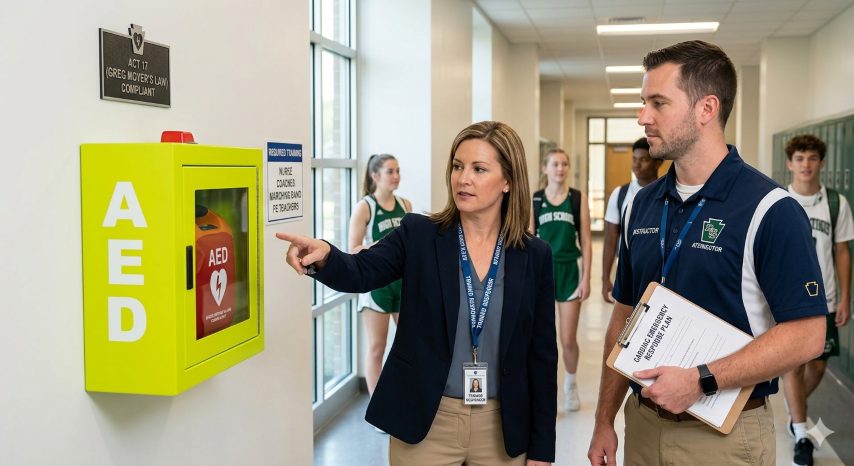
For schools participating in interscholastic athletics, the law requires AED readiness during athletic activities and practices. Schools must ensure that trained responders are available and that AEDs are readily accessible when students are participating in athletic events or practices.
This includes planning for more than just the main gym. Schools should review AED access for:
- Outdoor fields
- Stadiums
- Practice areas
- Locker rooms
- Field houses
- Remote areas of campus
- Events held outside normal school hours
The “Locked Door” Trap
An AED locked securely inside the nurse’s office or main administration building may not be truly useful during an afternoon football practice, a weekend track meet, or an outdoor athletic event on the far side of campus.
The key question for school leaders is simple: Can a trained responder get to the AED and bring it back fast enough to matter?
That is why AED placement, visibility, access, and staff training all need to be reviewed together.
The Core of the Law: Cardiac Emergency Response Plans (CERPs)
Owning an AED is only half the battle. The real life-saving power lies in a practiced, coordinated response.
Act 17 requires schools participating in interscholastic athletics to develop or update a comprehensive Cardiac Emergency Response Plan, often called a CERP.
A strong CERP should outline:
- The exact locations of AEDs on school premises and athletic areas
- Clear steps to take when someone collapses from suspected cardiac arrest
- Who calls 911
- Who starts CPR
- Who retrieves the closest AED
- How staff communicate during the emergency
- How the school coordinates with local Emergency Medical Services (EMS)
- How cardiac emergency information is shared with staff, students, and families
- How the plan will be reviewed and practiced
This is where the law moves beyond simple equipment ownership. A school should not only have an AED. It should have a plan for who uses it, where it is located, and how quickly it can be brought to the person in need.
Annual Drills and Practice
A plan on paper will not save a life if staff freeze during a crisis.
Schools participating in interscholastic athletics are required to conduct annual sudden cardiac arrest response drills. These drills may be conducted with or without student participation.
The goal is to build confidence and reveal weak spots before a real emergency happens.
A drill may uncover practical issues such as:
- An AED cabinet that is hard to open
- A device located too far from an athletic field
- Staff confusion about who calls 911
- Poor communication between indoor and outdoor areas
- Expired AED pads or batteries
- A lack of backup trained responders
Practice turns a written plan into a real response.
AED Maintenance and Readiness
Schools must actively maintain their life-saving equipment according to manufacturer guidelines and Department of Health specifications.
Dead batteries and expired pads can turn an AED into an expensive wall decoration. A device may be present, but if it is not maintained, it may not be ready when someone needs it most.
Essential AED Maintenance Log
| Tracking Metric | Requirement / Action |
|---|---|
| Device Location | Must be clearly marked, visible, unhindered, and easily accessible. |
| Battery Life | Track installation and expiration dates. |
| Electrode Pads | Monitor expiration dates for adult and pediatric pads. |
| Inspection Log | Assign a specific staff member to perform and document regular visual checks. |
| Replacement Schedule | Budget ahead for batteries, pads, cabinets, signage, and device replacement. |
A simple spreadsheet can help schools avoid last-minute surprises and make annual reporting easier.
Annual Reporting Requirements
To ensure accountability across the state, annual AED inventory reporting to the Pennsylvania Department of Education begins by June 30, 2027.
Every year, schools must submit AED readiness information, including:
- The number of AEDs owned
- The age of each device
- The model and condition of each AED
- Pad and battery expiration dates
- Specific placement locations throughout school buildings and grounds
Organizing this data now can prevent a chaotic administrative scramble when reporting requirements begin.
AED Purchasing Program and Funding Options
To help schools acquire and maintain AEDs, Act 17 establishes a statewide AED purchasing program.
The Department of Education will issue competitive invitations to bid, allowing school entities and nonpublic schools to purchase AEDs and replacement supplies at reduced contract pricing.
The law also addresses funding support.
For public schools, AED training is added as an allowable use under certain school safety and security grant categories.
For nonpublic schools, the law provides grant funding support to assist with AED equipment and CPR/AED training compliance requirements.
This is especially important for smaller schools that may need to purchase multiple devices, replace older AEDs, or train several staff members at once.
Liability Protections
Greg Moyer’s Law also reinforces Good Samaritan-style civil immunity protections for school employees, volunteers, and trained individuals who step in to use an AED or perform CPR during an emergency.
These protections are important because hesitation can cost precious time. When someone collapses from suspected sudden cardiac arrest, immediate action matters.
Disclaimer: This section provides a general summary of the law and should not be treated as formal legal advice. School administrators should consult their legal counsel regarding specific liability, insurance, and compliance questions.
What Pennsylvania Schools Should Do Now
Full compliance with the foundational training, placement, and emergency planning elements of Act 17 is required no later than three years from the law’s effective date. However, smart school administrators should begin preparing now.
1. Conduct a Comprehensive AED Audit
Map your campus and inventory every AED. Include device location, model, age, battery expiration date, pad expiration date, cabinet location, signage, and condition.
2. Review Staff Credentials
Audit current CPR and AED certifications for school nurses, coaches, athletic trainers, physical education teachers, marching band directors, and other trained staff.
3. Identify Coverage Gaps
Make sure every school building has trained responder coverage during each school day. Build backup plans for absences, substitutes, and multiple-building campuses.
4. Review Athletic AED Access
Look closely at gyms, fields, stadiums, locker rooms, and off-hour practice locations. Ask whether an AED is truly readily accessible from each area.
5. Draft or Update Your CERP
Use nationally recognized guidance, such as American Heart Association cardiac emergency response planning resources, to build or update your Cardiac Emergency Response Plan.
6. Schedule Annual Drills
Do not wait for an actual emergency to test the plan. Practice helps staff respond faster and exposes weak points before lives are on the line.
7. Partner with a Certifying Training Provider
Secure an ongoing training plan to certify required staff and make CPR/AED instruction available to employees and volunteers on a regular schedule.
How In-Pulse CPR Can Help Your School Prepare
Navigating new state requirements can feel overwhelming, but your school does not have to build its CPR and AED training strategy alone.
In-Pulse CPR provides official, hands-on American Heart Association CPR, AED, and Basic Life Support (BLS) training for schools and educational staff.
Our instructors can come directly to your school campus for convenient on-site group training sessions. We can help your nurses, coaches, physical education teachers, athletic staff, marching band directors, and other employees receive the training they need in an interactive classroom setting.
We also provide training documentation, making it easier for your school to track completed certifications and plan future renewals.
Do not wait until the compliance deadline closes in. Protect your students, empower your staff, and prepare your school with confidence.
Contact In-Pulse CPR today to schedule an on-site group CPR and AED training session for your Pennsylvania school.
Frequently Asked Questions
Does every single Pennsylvania school employee need to be CPR certified?
No. The law requires schools to make CPR and AED instruction available to employees and volunteers at least once every two years. However, certification is specifically required for certain roles, including school nurses or designees, athletic coaches, physical education teachers, athletic trainers, and marching band directors.
Do schools need to have an AED at outdoor sports practices?
Schools participating in interscholastic athletics must ensure that AEDs are readily accessible during athletic activities and practices. For outdoor fields, stadiums, or remote practice areas, schools should carefully review whether an AED locked inside the main building would truly be accessible fast enough during an emergency.
When do Pennsylvania schools legally have to meet these requirements?
Annual AED inventory reporting to the Pennsylvania Department of Education begins by June 30, 2027. The broader operational requirements, including required training, school-day responder coverage, CERP planning, and athletic AED readiness, must be satisfied no later than three years from the law’s effective date.
Do schools need to report AED information every year?
Yes. Schools must report AED inventory and readiness information annually, including the number of AEDs, condition, age, expiration dates, and locations.
Why does this law matter for local Pennsylvania communities?
Before Act 17 of 2026, AED access and cardiac emergency planning varied from school to school. Greg Moyer’s Law creates a more consistent statewide safety standard. That means students, staff, families, and spectators should benefit from stronger emergency planning whether they are at their home school, an away game, or a school-sponsored athletic event in another community.