


Allergy Management: From Common Triggers to Critical Response (Interactive Guide)
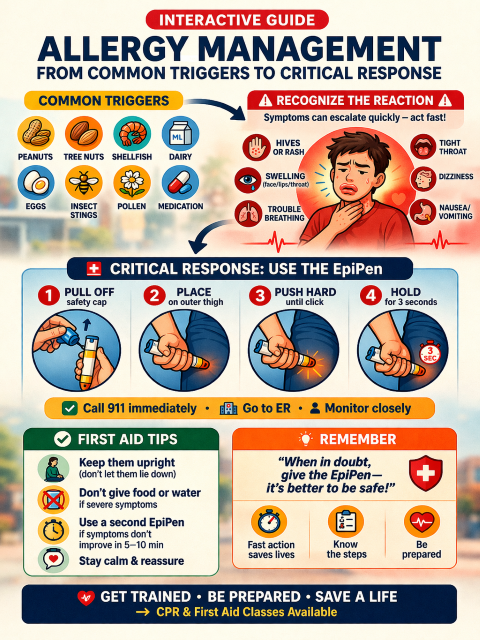
Understanding the Biological Trigger
To respond effectively, it is helpful to understand what is happening inside the body. An allergic reaction is essentially a case of “mistaken identity” by the immune system.
When an allergen enters the body, the immune system produces Immunoglobulin E (IgE) antibodies. these antibodies travel to cells that release chemicals, most notably histamine.
In a severe reaction (anaphylaxis), this chemical release becomes systemic, causing blood vessels to leak fluid into surrounding tissues (swelling) and causing blood pressure to drop dangerously.
Interactive: Is It a Mild Reaction or an Emergency?
Click each symptom below to see how allergic reactions can range from uncomfortable to life-threatening.
Tap a symptom group above
Learn how symptoms can escalate and when fast first aid action matters most.
🧠 Identify the Reaction
Select symptoms:
⏱️ How Allergic Reactions Escalate
💉 How to Use an EpiPen
🚨 Emergency Scenario: Would You Know What To Do?
Step-by-Step: Using an Epinephrine Auto-Injector
While your article mentions using an EpiPen, providing the mechanical steps can reduce panic during an actual emergency.
- Prepare: Flip open the case and remove the injector. Grasp the unit with an orange tip pointing down (never put your thumb over either end).
- Unlock: Pull off the blue safety release.
- Inject: Swing and push the orange tip firmly against the outer mid-thigh until it "clicks." It can go through clothing.
- Hold: Keep the injector pressed against the thigh for 3 full seconds.
- Seek Help: Even if symptoms improve, you must call emergency services, as a "biphasic reaction" (a second wave of symptoms) can occur hours later.
Rare and Unusual Allergic Reactions
While we typically think of allergies as a reaction to something we eat or breathe, the immune system can sometimes react to physical forces or environmental elements. These rare conditions highlight how complex—and sometimes unpredictable—our bodies can be.
- Water (Aquagenic Urticaria): One of the rarest conditions known, where skin contact with water of any temperature causes painful, itchy hives.
- Sunlight (Solar Urticaria): Not a standard sunburn, but a rapid immune response to UV radiation or visible light that triggers welts within minutes.
- Vibration (Vibratory Urticaria): Physical "shaking" from activities like jogging, lawnmowing, or even a bumpy car ride can cause localized swelling and a metallic taste in the mouth.
- Cold (Cold Urticaria): A sudden drop in temperature—like a cold breeze or jumping into a pool—triggers hives. This can be dangerous if it leads to a full-body reaction (anaphylaxis) while swimming.
- Red Meat (Alpha-gal Syndrome): Triggered by a bite from the Lone Star Tick, this causes a person to become allergic to a sugar found in mammalian meat (beef, pork, lamb). Unlike most food allergies, the reaction is often delayed by 3 to 6 hours.
- Physical Touch (Dermatographia): Often called "skin writing," where the slightest pressure or scratch causes the skin to swell into a raised, red welt in that exact shape.
- Exercise-Induced Anaphylaxis: A rare condition where physical exertion itself triggers a severe reaction. In some cases, this only happens if a specific "trigger food" was eaten a few hours before the workout.
- Your Own Sweat (Cholinergic Urticaria): A reaction to the rise in core body temperature, often causing tiny, itchy "heat bumps" during exercise or hot showers.
- Hormonal Changes: In very rare cases, individuals can develop a cyclical allergic rash that syncs with their natural hormone cycles.
- Human Seminal Plasma: A rare allergy to proteins found in semen, which can cause localized or systemic reactions.
- Is She allergic to me?
Comparing Common vs. Rare Triggers
| Type | Trigger Example | Typical Reaction Speed |
| Common (Food/Insect) | Peanuts, Bee Stings | Immediate (Seconds to Minutes) |
| Environmental | Pollen, Dust Mites | Ongoing / Seasonal |
| Physical (Rare) | Vibration, Cold, Water | Immediate upon contact |
| Biological (Rare) | Alpha-gal (Red Meat) | Delayed (3–6 Hours) |
Why Recognition is Vital
Whether a reaction is common or extremely rare, the physiological "panic" in the body is similar. For conditions like Cold Urticaria or Exercise-Induced Anaphylaxis, the risk of sudden, severe symptoms is high. Understanding these "strange" triggers ensures that even non-traditional symptoms are taken seriously and treated with the same urgency as a peanut allergy or a bee sting.
FAQ: Local Significance & Environmental Factors
Integrating local context helps readers understand risks specific to their geography and community resources.
| Question | Answer |
| Are certain seasons more dangerous in this region? | Yes. In many temperate climates, "pollen seasons" peak in spring (trees) and late summer (ragweed), significantly increasing the baseline "allergic load" for sensitive individuals. |
| How do I find local emergency resources? | Most local health departments provide maps of "Allergy-Friendly" public spaces or schools. You can also check if your local pharmacy participates in epinephrine disposal programs. |
| What are the local laws regarding auto-injectors? | Many regions have "Entity Acts" that allow schools, camps, and restaurants to maintain "stock" epinephrine for use on individuals without a personal prescription during an emergency. |
Expanded Prevention Checklist
To bolster the "Prevention and Preparedness" section, consider adding these professional protocols:
- The "Rule of Two": If you have a known severe allergy, carry two auto-injectors. About 15-20% of individuals may require a second dose if symptoms do not subside or if emergency services are delayed.
- Cross-Contamination Awareness: For food allergies, "hidden" allergens often reside on shared cutting boards, spatulas, or in frying oil.
- Digital Alerts: Save your allergy information in the "Medical ID" section of your smartphone so first responders can access it even if your phone is locked.
Summary Table: Mild vs. Severe Response
| Feature | Mild/Moderate Reaction | Severe (Anaphylaxis) |
| Skin | Hives, redness, itching | Pale/blue tinge, widespread swelling |
| Breathing | Runny nose, sneezing | Wheezing, tight throat, hoarse voice |
| Action | Antihistamines, observation | Epinephrine, Call 911 |
| Position | Comfortable sitting | Lying flat with legs raised |
🧪 Weird but True: Allergy Facts
Think you know allergies? Some of these are surprising. True or False?
Final Thought
Prompt action is the bridge between a medical emergency and a recovery. By recognizing the biological "red flags" and knowing how to use the tools at your disposal, you transform from a bystander into a lifesaver.
- Updated: How do bloodborne pathogens spread? March 2, 2026Siam BUnderstanding Blood-Borne Pathogens Blood-borne pathogens are infectious microorganisms present in blood and certain body fluids that can cause serious disease in humans. The most common include: • Hepatitis B (HBV)• Hepatitis C (HCV)• Human Immunodeficiency Virus (HIV) These pathogens are transmitted when infected blood or certain body fluids enter another person’s body through broken skin, mucous membranes, or ...
- What is Bloodborne Pathogens Training? May 25, 2022Donna RyanThe Occupational Safety and Health Administration (OSHA) supports bloodborne pathogens training. It is used to prevent the spread of bloodborne pathogens or viruses. The main pathogens include hepatitis B, hepatitis C, and the human immunodeficiency virus (HIV). Bloodborne pathogens training is not limited to healthcare workers. Therefore, anyone who works with or around patients can benefit ...
- How to Tell if Your Baby is Choking March 23, 2026Troy BowmanAs a baby starts to eat more solid food this becomes more and more of a possibility. This is complicated by the fact that some babies are more vocal than others which can make confusing for parents to know if their baby is really choking.
- When a fun day turns tragic: Choking hazard September 11, 2024Elayne BowmanChoking hazards for kids are everywhere It was on Christmas Eve, during a family gathering, when Joey grabbed a piece of hard candy and put it in his mouth. Joey was only 2 years old. No one saw Joey take the candy. They were all actively enjoying the festivities. Then in happened. Joey’s dad noticed that he ...