


Breaking Falls Safely – Home Playground Equipment
Breaking Falls Safely – Home Playground Equipment
Home Playground Safety: How to Reduce Injuries From Falls
Written by Susan Patterson
Updated November 2026 with current U.S. Consumer Product Safety Commission guidance.
Home playground equipment gives children a great way to climb, swing, slide, and burn off energy.
But backyard playsets also create real injury risks, especially from falls.
The good news is that many of those risks can be reduced before the first child ever climbs the ladder.
Proper surfacing, enough space around the equipment, good maintenance, and active supervision can make a home playground much safer.
Falls Are One of the Biggest Playground Hazards
The U.S. Consumer Product Safety Commission identifies falls as one of the major causes of playground injuries.
That is why the surface underneath and around a backyard playset matters so much.
Grass may look soft, but it can become compacted over time and does not provide the same impact protection as properly installed playground surfacing.
Concrete, asphalt, and other hard surfaces should not be used beneath equipment where a child could fall.
Instead, the goal is to create a shock-absorbing surface underneath and around the play structure.
What Should You Put Under a Home Playground?

CPSC guidance for outdoor home playgrounds recommends protective surfacing such as:
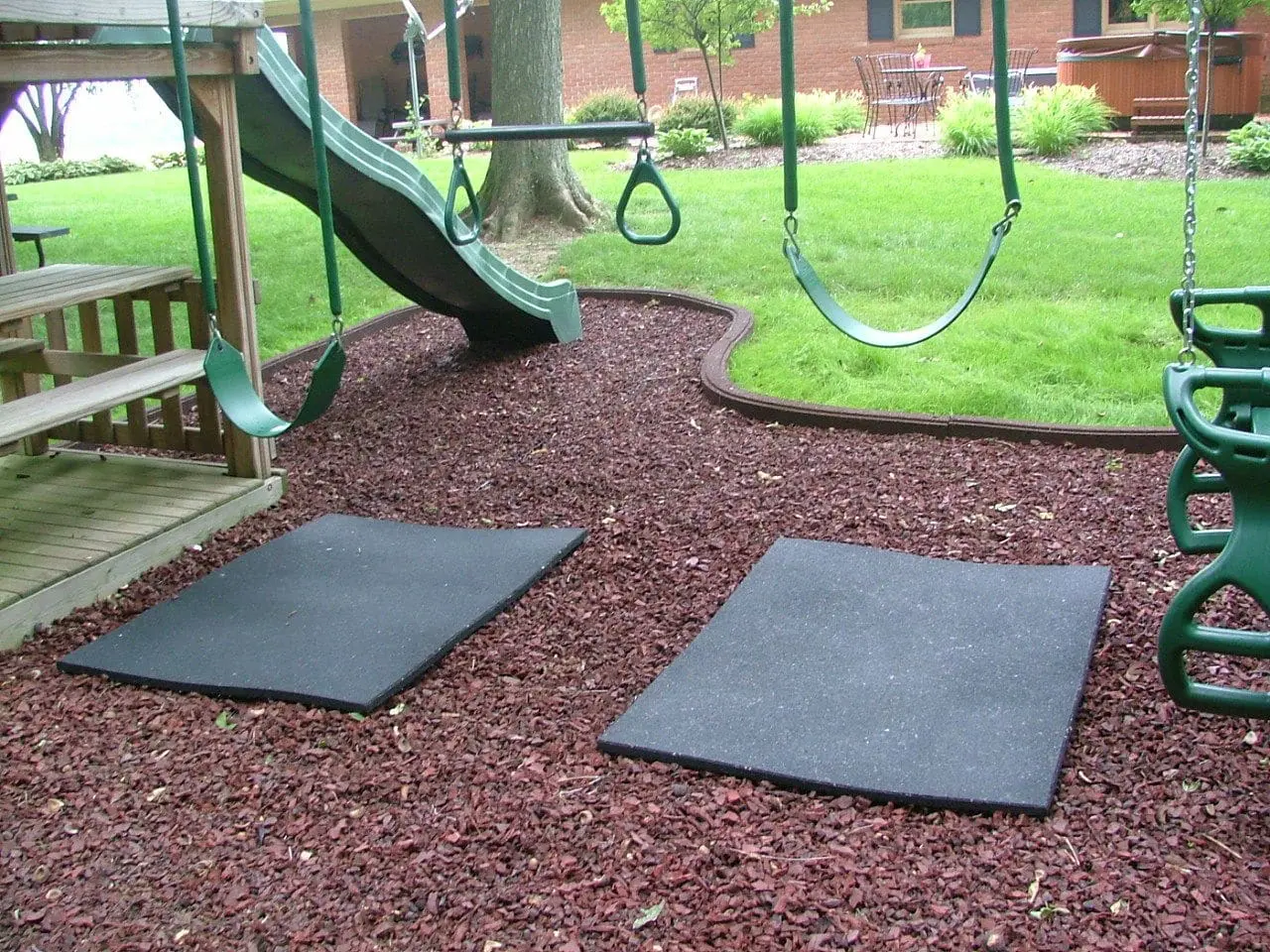
- Wood chips or wood mulch
- Engineered wood fiber
- Shredded rubber mulch
- Sand
- Pea gravel
- Safety-tested rubber or rubber-like mats
Thin carpeting or ordinary household mats are not adequate playground fall protection.
The right material depends partly on the height of the equipment.
How Deep Should Playground Surfacing Be?
This is one area where the older version of this article needed an update.
CPSC’s current home-playground guidance recommends maintaining about 9 inches of loose-fill protective material rather than relying on only 6 inches.
For typical residential play equipment:
- Wood chips, mulch, shredded rubber, and similar approved loose-fill materials may be used beneath taller equipment when installed at the proper depth.
- Sand and pea gravel are generally recommended for equipment with lower fall heights.
- Safety mats should be specifically tested and rated for an impact height at least as high as the equipment’s potential fall height.
The exact material and required depth should match the equipment manufacturer’s instructions and the impact rating of the surfacing product.
Do not assume that every type of mulch or rubber surface provides the same protection.
How Far Should Protective Surfacing Extend?
For most home playground equipment, CPSC recommends extending protective surfacing at least 6 feet in every direction beyond the equipment.
That means the fall-protection area should extend beyond the slide, climbing wall, platform, ladder, and other places where a child could fall.
The older idea of protecting only a few obvious landing spots is not the best approach.
Children do not always fall where adults expect them to.
Swings Need a Larger Fall Zone
Swings require extra clearance because children move through a much larger area.
For ordinary swings, CPSC recommends that protective surfacing extend in front of and behind the swing a distance equal to twice the height of the swing’s suspending bar.
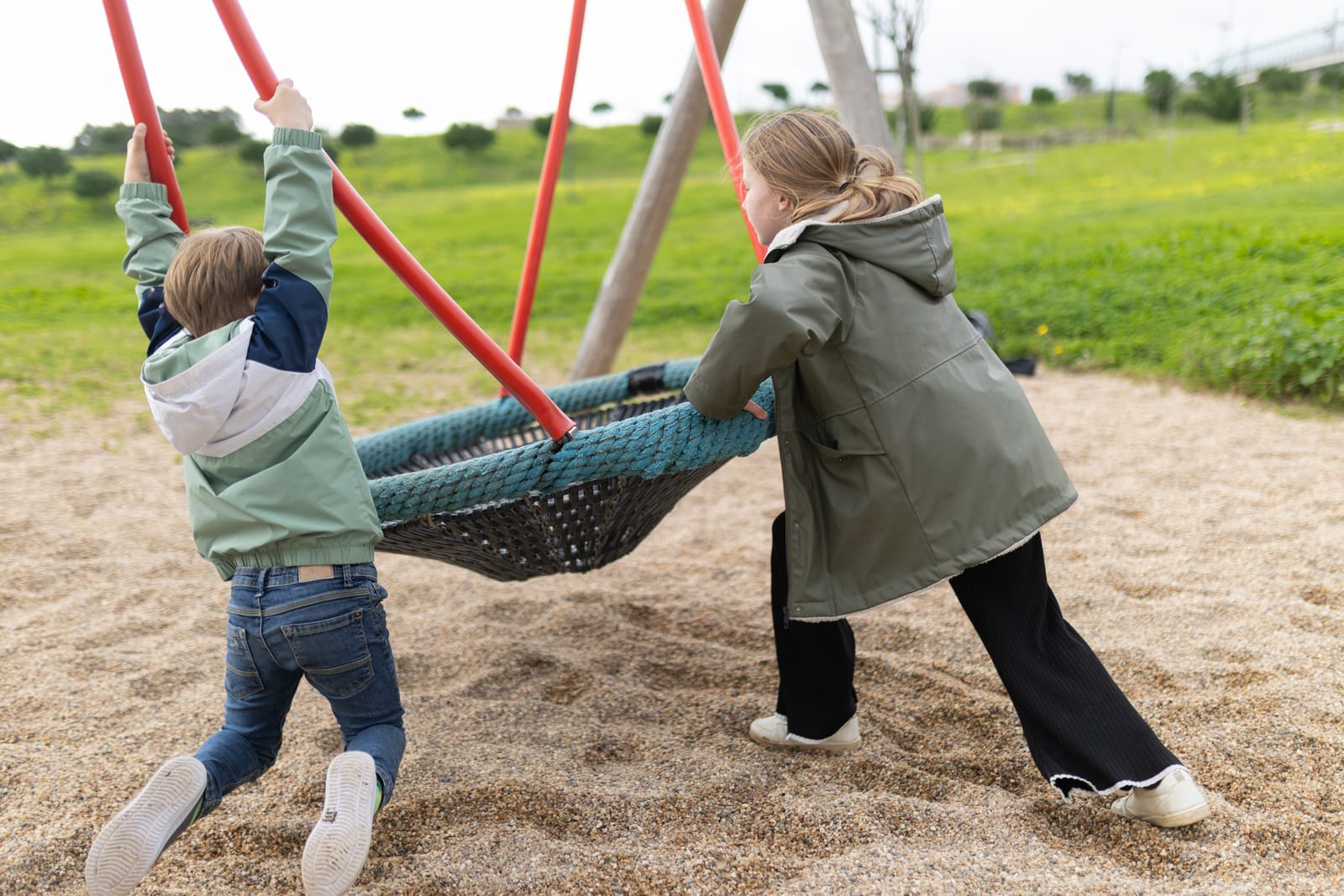
For example, if the swing beam is 8 feet above the ground, the protected area should extend roughly 16 feet in front of the swing and 16 feet behind it.
That space should also remain free of fences, trees, play structures, and other obstacles a swinging child could hit.
Rubber Mats Can Be a Good Option, but Check the Rating
Rubber playground tiles and poured or manufactured safety surfaces can be attractive because they do not scatter the way wood chips, sand, or mulch can.
But simply being made of rubber does not automatically make a surface safe.
CPSC recommends using mats or other unitary surfaces that have been tested for impact protection appropriate to the height of the equipment.
When shopping for playground surfacing, look for the product’s critical fall-height or impact rating.
The surface should be rated for at least the maximum fall height of your play equipment.
Loose-Fill Surfacing Needs Maintenance
Wood chips, mulch, sand, gravel, and shredded rubber move.
Children kick them away.
Rain redistributes them.
Material settles and compresses.
That means a playground that started with adequate protection may no longer have enough material several months later.
Check the depth regularly, especially:
- Under swings
- At the bottom of slides
- Below climbing equipment
- Around ladders
- At frequently used entrances and exits
Rake material back into place and add more when necessary.
CPSC specifically recommends periodically inspecting and maintaining both loose-fill surfacing and safety mats.
Check the Equipment, Not Just the Ground
A soft landing surface is only one part of home playground safety.
Parents should also inspect the playset itself.
Look for:
- Loose or missing bolts
- Protruding hardware
- Open S-hooks
- Cracked swing seats
- Worn chains or ropes
- Sharp edges
- Splintered wood
- Rust
- Unstable supports
- Exposed concrete footings
- Tree roots or rocks that create tripping hazards
CPSC recommends regular inspection of nuts, bolts, swing seats, ropes, chains, cables, surfacing, and structural components.
Watch for Entrapment Hazards
Children can become trapped when their bodies fit through an opening but their heads do not.
CPSC recommends eliminating hazardous openings in guardrails, ladders, and other parts of the play structure.
Openings should generally be either smaller than 3½ inches or larger than 9 inches to reduce the risk of head and neck entrapment.
This is particularly important on older or homemade playsets.
Never Attach Loose Ropes or Leashes to a Playset
Jump ropes, clotheslines, pet leashes, cords, and similar items should never be tied to playground equipment.
They can become strangulation hazards.
CPSC specifically warns against attaching these items to home playground equipment. Climbing ropes that are part of the equipment should be properly secured at both ends.
Children should also remove bicycle and sports helmets before playing on playground equipment because helmet straps can become caught in openings.
Guardrails Matter on Elevated Platforms
Platforms, ramps, and elevated areas should have appropriate guardrails or barriers.
CPSC recommends guardrails or barriers on platforms and ramps more than 30 inches above the protective surfacing.
Do not remove rails simply because a child has become more confident climbing.
Falls happen quickly.
Make Sure the Playset Cannot Tip Over
Outdoor playground equipment should be properly anchored according to the manufacturer’s instructions.
Anchors themselves should not create another hazard.
CPSC recommends burying or covering anchors with protective surfacing so children do not trip over them.
After storms, ground movement, or several seasons of use, check that the playset remains stable.
Supervision Still Matters
Good playground design reduces risk.
It does not eliminate it.
CPSC continues to recommend active adult supervision when children use playground equipment.
Supervision is especially important for younger children who may:
- Use equipment intended for older children
- Climb outside designated areas
- Walk in front of moving swings
- Stand on swing seats
- Jump from elevated platforms
- Use slides or climbing structures in unintended ways
The safest playground is one that combines good equipment, good surfacing, and attentive supervision.
What Should You Do After a Playground Fall?
Most playground falls result in minor bumps and scrapes.
But a significant fall can cause a head, neck, back, or other serious injury.
Call 911 when a child:
- Is unconscious or difficult to wake
- Is not breathing normally
- Has severe bleeding
- Has a seizure following an injury
- Has significant neck or back pain
- Cannot move normally after the fall
- Has a visibly deformed limb
- Shows signs of a serious head injury
- Has another condition that appears life-threatening
Avoid moving a child unnecessarily if you suspect a serious head, neck, or spinal injury unless the area itself is unsafe.
If the child is unresponsive and not breathing normally or is only gasping, begin CPR and follow the 911 dispatcher’s instructions.
CPR and First Aid Training Can Help Parents Respond
Preventing injuries is always preferable.
But children climb, run, tumble, and occasionally prove that gravity remains undefeated.
Knowing CPR and First Aid can help parents, grandparents, babysitters, teachers, and childcare providers respond when an ordinary fall becomes something more serious.
In-Pulse CPR provides hands-on American Heart Association CPR, AED, BLS, and First Aid training.
👉 View Upcoming CPR and First Aid Classes
Schools, childcare programs, churches, businesses, and other organizations can also arrange private training.
👉 Learn About Private On-Site CPR and First Aid Training
A backyard playground should encourage children to climb higher, swing farther, and play harder.
A little planning underneath their feet can make those adventures much safer.
Updated November 2026: This article was originally written by Susan Patterson and has been revised to reflect current U.S. Consumer Product Safety Commission guidance for home playground surfacing, fall zones, swings, equipment maintenance, entrapment hazards, and supervision.

COMMENT (1)
Best Rubber Mulch / May 19, 2012
According to the CPSC’s Public Playground Safety Handbook, rubber mulch is an appropriate playground surfacing material.
It has been proven that just a 6″ depth of rubber mulch (no need to compact it) will provide adequate fall protection for up to 10′-12′, whereas with wood chips you need to start with 12″ and compact it down to 9″ min.