

Tips for your First Automated External Defibrillator Purchase
Updated 2026 by Val
Tips for Your First AED Purchase
Written by Carin Mangimeli
Thinking about adding an AED to your workplace, school, or facility? It’s one of those decisions you hope you never have to rely on, but when it’s needed, it matters more than almost anything else in the room.
An AED (Automated External Defibrillator) is designed to help someone in sudden cardiac arrest by delivering a shock if needed. When it’s used quickly alongside CPR, survival rates go up significantly.
If you’re looking at purchasing your first AED, here are a few things worth thinking through before you decide.
Start with a Brand You Can Trust
There are several solid AED manufacturers out there, but a handful have built strong reputations over time for reliability and ease of use. In an emergency, simple matters. Clear voice prompts matter. A device that just works without hesitation matters.
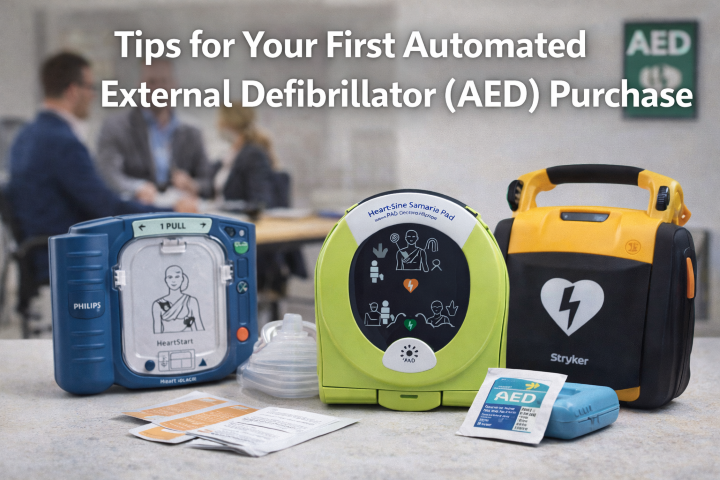
Some of the most commonly used brands include:
- Philips (HeartStart series)
- Stryker / Physio-Control (LIFEPAK series)
- ZOLL Medical
- HeartSine (Samaritan PAD series)
These are widely used by emergency responders and are designed to walk someone through the process step by step.
Ask Your Local Fire or EMS Team
Before you buy, it’s worth a quick call to your local fire department or EMS provider. They’ve seen these devices used in real situations, not just in product demos.
In some cases, they may recommend a specific model they see most often. That familiarity can help when seconds count and responders arrive on scene.
Training Changes Everything
AEDs are built to be used by everyday people, but training makes a big difference. It takes away hesitation and replaces it with action.
In most of our classes, students start a little unsure. By the end, they’re running through scenarios confidently and working as a team without overthinking it.
If you’re adding an AED, pairing it with CPR and AED training is one of the best decisions you can make.
Contact In-Pulse CPR to attend a local CPR and AED training class near you.
Think About Who You Serve
Most AEDs can be used for both adults and children, but some require pediatric pads or a setting adjustment. If you’re in a school, daycare, or youth program, that’s something you’ll want to have ready.
Also consider your environment. A busy gym or large facility may need a more robust setup, while a smaller office may just need a unit that’s easy to maintain and always ready.
Don’t Forget Maintenance
AEDs don’t require a lot of upkeep, but they do need attention. Pads expire. Batteries need to be checked. The unit should always be accessible and clearly marked.
Most newer models run self-checks and will show a clear indicator when everything is good to go. Still, someone should own the responsibility of keeping an eye on it.
Look Into Local Requirements
Depending on your state, there may be guidelines around AED programs. This can include training expectations, maintenance tracking, or registering the device with local emergency services.
There are also occasional grants or funding opportunities, especially for schools and community organizations, so it’s worth checking into that before purchasing.
Why This Matters
Cardiac arrest doesn’t wait for the perfect setting. It can happen at work, during a practice, in a hallway, or out in the parking lot.
Having an AED nearby, along with people who know how to use it, turns a bystander into someone who can actually help.
That’s really what this comes down to.
https://inpulsecpr.com/category/why-do-we-need-aed-training

COMMENT (1)
Troy Bowman / February 21, 2012
In-Pulse CPR now proudly sells ZOLL & HeartSine AED’s.
Comments are closed.