

Extreme Risks Can Lead to a Need for CPR
Updated September 2026 with current CPR and emergency-response information.
Teenagers sometimes believe they are invincible.
That confidence, mixed with alcohol and poor judgment, can turn a fun night into a life-threatening emergency in just a few seconds.
Imagine three recent high school graduates celebrating together at a friend’s house. With no adults home, and after drinking heavily, they decide to try something reckless—climbing onto the roof and jumping into the backyard pool.
At first, it sounds like harmless fun.
Then everything goes wrong.
When Fun Turns Dangerous
One teen jumps safely into the pool.
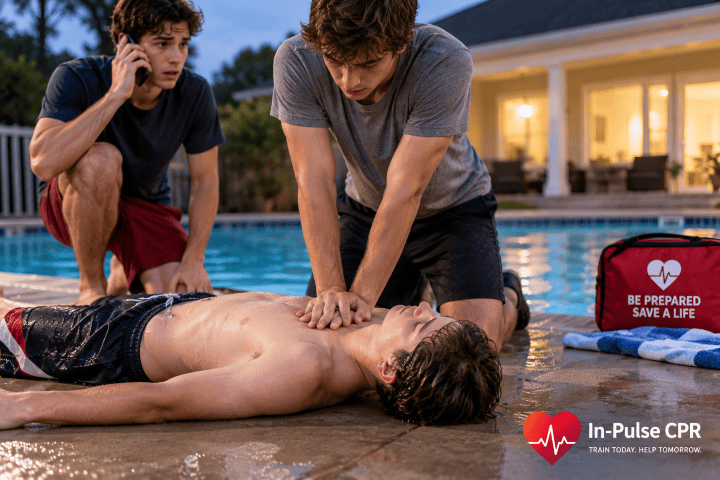
The second slips before making the jump and crashes onto the concrete beside the pool, striking his head.
Suddenly, what began as a celebration becomes a medical emergency.
His friends rush to him and realize he is unresponsive and not breathing normally.
In a moment like that, panic is natural.
But panic does not save lives.
Training does.
Why CPR Matters
If a person becomes unresponsive and is not breathing normally, CPR should begin immediately while someone calls 911 and gets an AED if one is available.
Current CPR training emphasizes:
- Calling 911 right away
- Starting chest compressions immediately
- Using an AED as soon as possible
- Continuing CPR until professional rescuers take over
When the victim is found near water, after trauma, or following another cause of oxygen deprivation, rescue breaths may also be especially important for trained rescuers.
That is why formal CPR training matters. It teaches not just the steps, but also how to stay focused and respond under pressure.
Poolside Emergencies Can Escalate Quickly
This kind of scenario also highlights several major dangers:
- Alcohol and swimming do not mix
- Roof jumping is not a sport—it is a serious injury risk
- Head injuries can become life-threatening in seconds
- A person who is unconscious near a pool may also be at risk of drowning
- Immediate action by bystanders can make the difference between life and death
Even when someone starts breathing again, that does not mean the emergency is over. A person with a head injury, loss of consciousness, or breathing emergency still needs prompt medical evaluation.
CPR Buys Time
CPR does not fix a skull fracture or reverse a serious head injury.
What it can do is help keep oxygenated blood moving to the brain and other vital organs until EMS arrives.
That is why CPR is so important.
You may never know when a normal day—or a foolish decision—could turn into a crisis.
Learn CPR Before You Need It
In-Pulse CPR provides hands-on American Heart Association CPR, AED, BLS, and First Aid training.
View Upcoming CPR Classes
You cannot prevent every emergency.
But you can be prepared to respond when one happens.
Updated September 2026: This article has been substantially revised to reflect current CPR principles and to emphasize the real dangers of alcohol, head injuries, and unsafe behavior around pools.
