CPR training requirement for H.O.P.E School Children in Florida

Florida students enrolled in the H.O.P.E. program (Health Opportunities through Physical Education) are required to receive CPR instruction as part of their health education curriculum. This requirement supports Florida’s commitment to student safety, emergency preparedness, and lifelong health awareness.

The H.O.P.E. course combines physical activity, wellness education, and practical health skills that students can use both in school and throughout their lives. CPR training plays a vital role in meeting those goals.


What Is the Florida H.O.P.E. Program?

The H.O.P.E. program is a state-approved elective designed to help students understand the connection between physical activity, healthy choices, and long-term wellness. In addition to fitness and nutrition education, the program emphasizes real-world skills that can save lives.

One of the most impactful skills taught through H.O.P.E. is Cardiopulmonary Resuscitation (CPR).


Why CPR Training Is Required for H.O.P.E. Students

Sudden cardiac arrest can happen anywhere, including schools, athletic events, and public spaces. When CPR is started immediately, survival rates increase significantly.

CPR education helps ensure students:

  • Recognize the signs of cardiac arrest

  • Call 911 quickly and confidently

  • Begin CPR until professional help arrives

Even school-aged students can safely and effectively respond when trained properly. The CPR requirement within the H.O.P.E. program ensures students are prepared to act rather than hesitate when every second counts.


CPR Training Builds Confidence and Preparedness

Many bystanders fail to act during emergencies simply because they are unsure of what to do. CPR training replaces uncertainty with confidence.

Students who complete CPR instruction are more likely to:

  • Step in during emergencies

  • Assist family members, classmates, and community members

  • Retain lifesaving skills long after graduation

By learning CPR in school, students carry these skills into adulthood, strengthening the safety of the entire community.


Approved CPR Training for Florida Schools

To meet H.O.P.E. program requirements, CPR instruction should be based on current, evidence-based resuscitation guidelines and delivered by qualified instructors. Training typically includes:

  • Adult CPR techniques

  • AED (Automated External Defibrillator) use

  • Hands-on skill practice

  • Recognition of cardiac emergencies

Courses may also include First Aid training when required by the school or district.

In-Pulse CPR provides American Heart–aligned CPR training for Florida students, schools, and organizations. Classes are available throughout the state and can be offered as public sessions or private group trainings for schools and youth programs.


CPR Certification for Florida Students

Most CPR courses provide a two-year certification upon completion. Training sessions typically run:

  • Approximately 4 hours for CPR and AED training

  • Approximately 6 hours when First Aid is included

Instruction is hands-on, engaging, and designed to ensure students understand both the “how” and the “why” behind CPR.


Support H.O.P.E. Requirements with In-Pulse CPR

CPR training through the H.O.P.E. program does more than fulfill a graduation requirement. It prepares students to take action in emergencies and helps create safer schools and communities across Florida.

View In-Pulse CPR’s Florida CPR classes or explore private group training options for schools to meet H.O.P.E. program requirements and build lifesaving confidence in students.

Now Offering Expanded AHA BLS & CPR Training Across the Twin Cities Metro


As healthcare and workplace safety requirements continue to evolve in 2026, In-Pulse CPR is proud to announce the expansion of our American Heart Association (AHA) training network. We’ve added more locations and more frequent sessions to better serve Minnesota’s healthcare professionals and corporate teams.

The In-Pulse Advantage:

  • No Online Pre-work: Skip the hours of tedious home modules. All training is completed in-class.
  • Fast AHA eCard Delivery: Most students receive their eCard the same day or by the next business day after successful completion.
  • High Efficiency: Get fully certified in one 3–3.5 hour in-person session.

Find Your Nearest Training Center

Core Twin Cities Metro

Minneapolis (Near U of M) | St. Paul (East Metro/Sun Ray) | Bloomington | Richfield | Minnetonka | Golden Valley

North Metro

Maple Grove | Brooklyn Park | Brooklyn Center | Blaine | Fridley | Shoreview | Anoka | Elk River

East Metro

Roseville | Woodbury | Stillwater | White Bear Lake | Cottage Grove

South Metro

Eagan (I-35E & I-494) | Burnsville (Medical District) | Apple Valley | Shakopee

Greater Minnesota

Rochester | St. Cloud | Albertville


Corporate & Group Training: Need to certify a large group? We can bring the classroom to your facility. Our instructors provide consistent, AHA-aligned training for nursing students, medical staff, and safety teams.

View Upcoming Minnesota Class Schedules

Pasco County School Staff Save 13-Year-Old with CPR + AED During Gym Class

CPR classes in Florida

In Pasco County, Florida, a middle school gym class turned into a life-saving emergency when 13-year-old Jonathan Jackson suddenly went into cardiac arrest while getting a drink of water. Thanks to the quick action of school staff and access to an AED, Jonathan survived and recovered — a powerful example of how CPR training and AEDs save lives.


What Happened at Crews Lake Middle School

On December 9, 2025, Jonathan collapsed unexpectedly during gym class at Crews Lake Middle School in Pasco County. His mother, Courtney Jackson, later shared that school personnel immediately recognized the urgency, called for help, and began performing CPR within moments of his collapse.

School staff also quickly retrieved an automated external defibrillator (AED) and used it to deliver multiple shocks to restore Jonathan’s heart rhythm, an essential step in his successful resuscitation.

Doctors later explained that without CPR and early defibrillation, the odds of surviving cardiac arrest — especially outside a hospital setting — are very low. Jonathan was hospitalized for several days but was ultimately diagnosed with a correctable condition and is now on the road to recovery.


Why This Story Matters Across Florida

Cardiac Arrest Can Happen to Anyone

Sudden cardiac arrest isn’t limited to older adults or people with known heart disease — it can strike young, active teens without warning. Jonathan’s experience highlights why awareness and preparedness are crucial in every setting, especially schools and youth activities.

Every Second Counts

Once the heart stops, brain damage can begin in minutes without oxygenated blood circulating. Immediate CPR slows this process and keeps critical blood flow going until more advanced care arrives.

AEDs Make a Huge Difference

AEDs are designed for use by everyday people, with voice prompts and easy instructions. They can detect abnormal heart rhythms and deliver a lifesaving shock — particularly when used early. Jonathan’s survival is another powerful example of how access to these devices in schools and public spaces can save children’s lives.


The Pasco County Response Plan in Action

Pasco County Schools has a districtwide AED program that ensures every school has at least one defibrillator available. The district also conducts regular training and emergency drills so staff are ready when every second matters.

“We wouldn’t be celebrating the holidays with our child if it weren’t for CPR and the AED,” Jonathan’s mom said, underscoring the emotional impact of preparedness and response training.


What Florida Communities Can Learn from This Story

This school emergency offers three key takeaways for families and communities across Florida:

1. CPR Training Saves Lives
Anyone who knows CPR increases the chance that a person experiencing cardiac arrest can be helped — whether at school, work, or home.

2. AEDs Should Be Everywhere
Public access to AEDs — in schools, gyms, parks, and community centers — creates a safety net that dramatically improves survival odds.

3. Prepared Staff Matter
When adults are trained and confident, children are safer. Regular drills and hands-on practice make a real difference when emergencies happen for real.


Be Ready When It Matters Most

Jonathan’s story is inspiring — but it’s also a call to action. Sudden cardiac arrest can strike anyone, and survival depends on those first critical minutes.

👉 Take an In-Pulse CPR + AED training course in Florida
Gain real skills, real confidence, and the ability to step in and save a life.

Whether you’re a parent, teacher, coach, or neighbor, CPR training empowers you to make a difference when every second counts.

Love Minnesota Hate Winter

Minnesota is one of the most beautiful states in the country. My spouse and I have traveled all over, and few places compare to what we have here. Endless lakes. Quiet forests. Sunrises that stop you mid-sip of coffee. Sunsets that look staged. Fishing, camping, biking, state parks, and about a billion other reasons to stay.

And yet.

Winter.

Every year it arrives like it owns the place and refuses to leave. This year is no different. Bitter cold shows up early and overstays its welcome, dragging windchills that sound made up to anyone who hasn’t experienced them.

People from other states have no real frame of reference for forty below windchill. It’s not just “cold.” It’s a full-body negotiation with physics.

Snot freezes in your mustache.
Your breath turns scarves and glasses into frosted-over science experiments.
Fingers and toes ache the way they do when you grab a hot pan barehanded and immediately regret every life choice that led to that moment.
Your eyelashes try to bond permanently with your forehead.

All of this happens while you’re just trying to walk from the house to the car.

Minnesotans endure it, of course. We layer up, complain professionally, and still manage to love where we live. We know winter is the price of admission for everything that comes after.

But honestly, if someone could invent a winter-rated space suit with decent mobility and a cup holder, I’d be first in line.

Until then, I’ll keep loving Minnesota.
And absolutely hating winter.

Hero Florida Deputy Uses CPR to Save 1-Year-Old Who Stopped Breathing

In Lehigh Acres, Florida, a life-and-death situation unfolded inside a home when a 1-year-old girl suddenly stopped breathing and became unresponsive. Thanks to the quick thinking and CPR skills of a Lee County deputy, this toddler got a second chance at life — a powerful reminder of why CPR training matters in every community.

A Life Saved Inside a Family Home

On October 28, 2025, the Lee County Sheriff’s Office responded to a call at a residence where a baby girl — later identified as Catalina — had stopped breathing and was unresponsive. Upon arrival, Deputy Curtis Redford quickly assessed the situation and immediately began performing CPR on the little girl while other responders prepared additional medical support.

Deputy Redford’s fast response — starting chest compressions right away — helped Catalina begin breathing on her own before emergency medical services (EMS) arrived at the scene. Her family later expressed deep gratitude for the deputy’s actions and highlighted the importance of CPR awareness among parents and caregivers.

Why This Florida CPR Story Matters

Cardiac & Respiratory Emergencies Can Happen at Any Age

Although it’s more common to associate cardiac arrests and breathing emergencies with adults, children and infants can experience sudden life-threatening events — like complications from febrile seizures, choking, or underlying medical conditions. Catalina’s case shows that when every second counts, immediate action matters.

Immediate CPR Buys Crucial Time

When someone — especially a child — stops breathing and loses a pulse, oxygen stops reaching vital organs within minutes. CPR keeps blood flowing to the brain and heart until professional help arrives, dramatically improving chances of survival.

Law Enforcement as First Responders Can Make Lifesaving Differences

Deputies, police officers, and other first responders often arrive before EMS in urgent emergencies. Deputy Redford’s rapid initiation of CPR underscores why CPR skills are essential not just for medical professionals but for anyone who might be first on the scene.

How Florida Families Can Be Prepared

This inspiring story is more than uplifting — it’s instructional. It highlights the value of having CPR knowledge and readiness before an emergency happens:

  • Learn Infant & Child CPR Techniques
    Babies and children require different compression depth and rhythms than adults — and training ensures you know the correct method.
  • Stay Calm & Act Quickly
    A well-practiced response can turn panic into lifesaving action when precious minutes matter most.
  • Encourage CPR Training Across Your Community
    From parents to teachers, caregivers to neighbors, CPR training empowers everyday people to save lives.

Ready to Act When It Matters Most?

Catalina’s survival isn’t just a news headline — it’s a testament to the power of knowing what to do before help arrives.

👉 Take an In-Pulse CPR course in Florida — get hands-on training in infant, child, and adult CPR + AED use. Build the confidence and ability you need to respond quickly in an emergency.

Your training could be the reason someone gets a second chance at life.

Florida Deputies and Bystander CPR Save 4-Year-Old on Interstate 275: A Lifesaving Reminder

Hillsborough County, FL (Jan 25, 2026) — A dramatic lifesaving effort unfolded on Interstate 275 when Hillsborough County Sheriff’s Office deputies and an alert bystander performed emergency CPR on a 4-year-old boy who was found unresponsive, not breathing, and without a pulse. The quick action helped keep the child alive until paramedics could take over and transport him to St. Joseph’s Hospital, where he is now reported in stable condition.

This incident reinforces a powerful reality: CPR saves lives — especially when started immediately by trained public responders.


What Happened on I-275?

On the evening of January 24, Hillsborough County deputies responded to a “person down” call on Interstate 275 near Tampa. When they arrived on the scene, the young boy was unresponsive and had no detectable pulse.

A bystander was already performing CPR, and deputies quickly joined in, continuing chest compressions until Tampa Fire Rescue crews could take over lifesaving measures. The child was then taken to the hospital in stable condition.

This real-life rescue highlights just how critical immediate bystander CPR and coordinated response can be when every second counts.


Why This Florida CPR Story Matters

Immediate CPR Makes the Difference

When someone stops breathing and their heart stops beating, brain damage can begin in as little as 3–5 minutes without oxygen. Performing CPR helps maintain vital blood flow until professional help arrives — and can literally mean the difference between life and death.

Training and Preparedness Save Lives

In this Hillsborough County case, a bystander already started CPR before deputies arrived — showing the impact that even basic CPR knowledge can have in a community emergency. Deputies continued compressions, stabilizing the child until paramedics arrived and transported him for further care.

Florida Families Should Be Ready

Florida is home to families, schools, community events, and thousands of everyday moments where the unexpected can happen. This incident is a powerful reminder that:

  • Cardiac emergencies can occur anywhere, at any age
  • Anyone nearby can be the person who steps in first
  • CPR and AED readiness are essential skills in every neighborhood

Learn CPR and Be Prepared to Act

This inspiring Hillsborough County rescue isn’t just a news headline — it’s a call to action. CPR isn’t only for first responders. Parents, teachers, grandparents, coaches, and neighbors can all make a lifesaving difference by knowing what to do.

Why Get CPR Certified?

  • You’ll know how to perform high-quality chest compressions
  • You’ll be ready to use an AED confidently
  • You’ll be prepared to help before help arrives

👉 Sign up for an In-Pulse CPR course in Florida today and build muscle memory, confidence, and lifesaving skills that prepare you to act when it counts most.

Don’t wait for an emergency — be the person who saves a life.

Minnesota CPR & AED Save a Life at Hastings Bar: A Heart-Stopping Story You Need to Read

Hastings, Minnesota isn’t just known for its small-town charm — recently it became the setting for a powerful real-life reminder of why CPR and AED readiness matters. A sudden cardiac arrest in a local bar turned into a near-tragedy that ended in survival, all because someone knew what to do and had the right tools nearby.

The Moment That Changed Everything

On a typical evening at Dugarel’s Bar and Grill in Hastings, something unexpected happened — a man suddenly collapsed from cardiac arrest in front of other patrons.

An off-duty paramedic, Lucas Kanoll, happened to be inside the establishment. He immediately stepped in to help. Recognizing the emergency, Lucas began chest compressions and then instructed a server to bring the nearby Automatic External Defibrillator (AED).

Once the AED advised a shock and was used, Lucas resumed compressions — and the man began to regain a pulse. He was later taken to the hospital, where doctors placed two stents in his heart. Without those critical early minutes of CPR and AED shock, the outcome could have been very different.

Why This Hastings Save Matters to All Minnesotans

Lives Depend on Seconds

Cardiac arrest outside a hospital is one of the few medical emergencies where immediate action directly predicts survival. Every minute without CPR and defibrillation reduces the chance of survival significantly. Even with fast EMS response, it still takes time to arrive — time that CPR & AED use buys.

AEDs in Public Places Save Hearts

The AED at Dugarel’s wasn’t there by accident. It was placed through a local initiative involving community members, the Hastings Fire Relief Association, and programs like Allina Health Heart Safe Communities, which place and register AEDs across the region.

Because the device was already on site, and because someone knew how to use it, a life was saved.

Everyday People Are Lifesavers

Lucas was off-duty, and the bar patrons were just going about their evening. What brought them together in that moment was response readiness — a willingness to act fast, start compressions, and use an AED when every second counted.

What Minnesotans Should Know

These facts are worth remembering:

• Cardiac arrest strikes without warning.
You never know when someone around you — a friend, family member, coworker, or stranger — may need help.

• Survival improves dramatically with CPR + AED.
Bystander CPR with early defibrillation can more than double a victim’s chance of survival.

• AED access matters.
Having devices in businesses, gyms, bars, and public spaces makes lifesaving tools immediately available.

How You Can Be Ready to Save a Life

This Hastings story is inspiring, but it’s also a clear call to action for everyone in Minnesota:

1. Get Certified in CPR

Hands-on training builds confidence, muscle memory, and preparedness to act in real heart emergencies.

2. Learn AED Use

Modern AEDs are designed for simplicity, with spoken prompts that guide users through defibrillation safely and quickly.

3. Advocate for AEDs in Your Community

Encourage local businesses, schools, gyms, and venues to install AEDs and register them with public safety apps.


Don’t Wait — Learn CPR & AED Today

Cardiac emergencies don’t wait for the perfect moment. But with proper training and AED awareness, you can be the difference between life and death.

👉 Sign up for In-Pulse CPR’s hands-on CPR & AED course in Minnesota — build skills that prepare you to help others confidently and effectively.

Every minute counts.
Be the responder.
Be the one who acts.

Updated 2026: Babysitters in Pennsylvania Understand the Importance of Knowing CPR and First Aid

Be Ready When It Counts

Babysitting is not just supervision. It is responsibility. When parents leave their children with a sitter, they expect more than someone who can keep them entertained. They expect someone who can respond when something goes wrong.

In Pennsylvania, babysitters who are trained in CPR and First Aid stand out immediately. They are seen as safer, more reliable, and more professional.


Why CPR and First Aid Matter for Babysitters

Children can experience:

• Choking
• Breathing problems
• Asthma attacks
• Allergic reactions
• Pool and water emergencies
• Falls and injuries

A CPR-trained babysitter knows how to:

• Perform CPR on infants, children, and adults
• Use an AED
• Clear airway obstructions
• Control bleeding
• Provide care until EMS arrives

That training turns panic into action.


Heartsaver CPR, AED, and First Aid for Babysitters

In-Pulse CPR is an American Heart Association Training Center that provides Heartsaver CPR, AED, and First Aid training designed for non-medical caregivers like babysitters and nannies.

The program includes:

• Infant, child, and adult CPR
• AED use
• Choking response
• Bleeding and injury control
• Emergency scene assessment

Certification is valid for two years and is widely accepted by parents, childcare agencies, and schools.


Hands-On, Instructor-Led Training

Classes are taught by experienced instructors and include hands-on practice using CPR manikins and AED trainers. Babysitters learn:

• Proper chest compressions
• Rescue breathing
• AED pad placement
• How to evaluate an emergency

This builds real confidence, not just classroom knowledge.


Train Locally Across Pennsylvania

In-Pulse CPR offers classes throughout Pennsylvania, including:

York, Hershey, Lancaster, West Chester, King of Prussia, Mechanicsburg, and Allentown.

Classes are offered mornings, evenings, and weekends.


Flexible Class Options

We offer:

• Private group classes for 5 or more students
• Hundreds of public classes every year
• Same-day American Heart Association eCards

Whether you are a teen sitter or an adult caregiver, you can find a class that fits your schedule.


Be the Babysitter Parents Trust

Parents look for babysitters who are trained, prepared, and calm under pressure. CPR and First Aid certification shows that you take their child’s safety seriously.

Get certified before your next babysitting job.

View Pennsylvania CPR & First Aid Class Calendar →


Across the country, babysitters and childcare providers are recognizing how critical CPR and First Aid training is when caring for children. These real-world stories highlight how caregivers in different states are preparing themselves to respond confidently in emergencies.

Updated 2026: Minnesotan Babysitters Should Receive Heartsaver CPR and Heartsaver First Aid before Accepting Work

Build Trust Before You Take Responsibility

If you live in Minnesota and plan to earn money babysitting, CPR and First Aid training should come first. Parents are no longer just hiring someone to watch their child. They are trusting someone with their child’s life.

Babysitters ages 11 and up can dramatically increase their credibility and job opportunities by earning American Heart Association Heartsaver CPR, AED, and First Aid certification.


CPR and First Aid Training Designed for Babysitters

In-Pulse CPR is a Minnesota-based American Heart Association Training Center that provides CPR and First Aid programs tailored specifically for babysitters, nannies, and youth caregivers.

We offer:

• Private group classes for 5 or more students
• Hundreds of public classes across Minnesota every year
• Same-day AHA digital certification
• Child, infant, and adult emergency training

Classes are practical, not medical-school style. Everything is built around the situations babysitters actually face.


Why Babysitters Need CPR Training

Children can experience:

• Choking
• Breathing emergencies
• Asthma attacks
• Allergic reactions
• Pool and water accidents
• Falls and injuries

A CPR-trained babysitter knows how to:

• Perform CPR on infants, children, and adults
• Use an AED
• Clear airway obstructions
• Control bleeding
• Provide emergency care until help arrives

That knowledge can make the difference between panic and lifesaving action.


Heartsaver CPR, AED, and First Aid for Babysitters

The American Heart Association Heartsaver program is the national standard for babysitters and childcare workers.

It includes:

• Infant, child, and adult CPR
• AED use
• Choking response
• Bleeding and injury control
• Emergency scene assessment

Certification is valid for two years and is widely accepted by parents, schools, childcare agencies, and insurers.


Hands-On, Instructor-Led Training

Every class includes hands-on practice using CPR manikins and AED trainers. Babysitters practice:

• Chest compressions
• Rescue breathing
• AED pad placement
• Realistic emergency scenarios

This builds confidence that shows when parents ask, “What would you do if something happened?”


Train Locally Across Minnesota

In-Pulse CPR offers classes in communities including:

Albertville, Eden Prairie, Maple Grove, Roseville, Burnsville, Apple Valley, Woodbury, Rochester, Inver Grove Heights, Eagan, Elk River, Plymouth, and Bloomington.

Classes are held mornings, afternoons, evenings, and weekends.


Be the Babysitter Parents Choose

Parents prefer babysitters who are CPR and First Aid certified because it shows responsibility, professionalism, and readiness.

Get trained before you take your next babysitting job.

View Minnesota CPR & First Aid Class Calendar →


Related Stories: Babysitters & Childcare CPR Training

Across the country, babysitters and childcare providers are recognizing how critical CPR and First Aid training is when caring for children. These real-world stories highlight how caregivers in different states are preparing themselves to respond confidently in emergencies.

Updated 2026: Tampa Babysitters Need to Understand CPR before They Take on an Assignment

Be Prepared Before You Watch Someone Else’s Child

Any Florida babysitter, age 12 and up, should be trained before taking responsibility for a child’s safety. Parents today expect more than just a friendly face. They want someone who can act quickly and correctly in an emergency.

Children get hurt. Choking happens. Pools, playgrounds, asthma, allergies, and falls all create real risk. Walking into a babysitting job without CPR and First Aid training is no longer acceptable in 2026.


CPR and First Aid Training Designed for Babysitters

In-Pulse CPR is a local American Heart Association Training Center that offers CPR and First Aid programs specifically suited for babysitters, nannies, and youth caregivers across Florida.

We provide:

• Small-group private classes (5+ students)
• Public classes held weekly across Florida
• Courses designed for child, infant, and adult emergencies
• Same-day digital AHA certification

Our training is built for real-world situations babysitters actually face, not hospital environments.


Why Babysitters Need CPR Training

A trained babysitter can:

• Recognize breathing emergencies
• Perform CPR on infants, children, and adults
• Use an AED if needed
• Stop bleeding
• Respond to allergic reactions
• Handle choking incidents
• Stay calm and make smart decisions under pressure

These skills save lives while waiting for EMS to arrive.


Heartsaver CPR and First Aid for Babysitters

Babysitters in Florida typically take the American Heart Association Heartsaver CPR AED and First Aid course.

This program is designed for people without medical backgrounds and includes:

• Infant, child, and adult CPR
• AED use
• Choking response
• Bleeding control
• Burns, shock, and injury response
• Emergency scene assessment

The certification is valid for two years and is widely accepted by parents, childcare agencies, and insurance providers.


Hands-On, Instructor-Led Training

Classes are interactive and practical. Students practice:

• Chest compressions
• Rescue breathing
• AED pad placement
• Emergency response scenarios

This builds real confidence, not just classroom knowledge.


Train Locally in Florida

Whether you live in Tampa, Clearwater, Orlando, or Fort Myers, In-Pulse CPR offers convenient classes throughout Florida with flexible scheduling and same-day certification.

Many babysitters who are CPR-certified receive more job offers and higher pay because parents trust them more.


Be the Babysitter Parents Choose

CPR and First Aid training is no longer optional. It is the standard parents expect.

Get certified now and be ready when it matters.

View Florida CPR & First Aid Class Calendar →


Across the country, babysitters and childcare providers are recognizing how critical CPR and First Aid training is when caring for children. These real-world stories highlight how caregivers in different states are preparing themselves to respond confidently in emergencies.

Dauphin County Teen’s Quick CPR Action Saves Father’s Life

In Dauphin County, Pennsylvania, what began as an ordinary afternoon took an extraordinary turn — all because a teenager knew how to act fast.

A local teen, enrolled in his high school health class just weeks earlier, used his newly learned CPR skills to save his father’s life after he suddenly collapsed at home with a cardiac emergency.

Real Training Meets Real Emergency

According to local news reports, the teen recognized that his father was unresponsive and not breathing properly. He immediately began performing chest compressions, using the CPR techniques he had recently practiced at school.

Emergency responders credited the swift CPR with keeping vital blood flow circulating until paramedics arrived on scene — a crucial bridge between collapse and professional medical care.

Why This Story Matters for Pennsylvania Families

This powerful moment highlights four essential truths:

1. CPR Training Works — Even After Just Weeks
The teen’s training was recent and fresh in his mind — and that preparedness made all the difference.

2. Cardiac Arrest Can Strike Anyone, Anytime
His father’s collapse was sudden and unexpected — showing that cardiac emergencies don’t wait for a convenient moment.

3. Immediate Action Significantly Improves Survival Odds
Every minute without effective CPR drops the chance of survival dramatically — making bystander intervention vital.

4. Young People Can Be Lifesavers
This teen didn’t hesitate — he stepped up with confidence and skill. That’s exactly what CPR training aims to build.

What Pennsylvania Can Learn From This Heroic Act

Stories like this aren’t just inspiring — they’re instructive. They remind us that:

• CPR skills are not just for healthcare professionals
• Schools and communities should encourage widespread CPR education
• Knowing what to do can turn a bystander into a lifesaver

Your Turn to Be Ready

Most people will never expect to face a cardiac emergency — until the moment it happens. But that doesn’t mean you can’t be prepared.

💡 In-Pulse CPR offers hands-on training that builds muscle memory, confidence, and real readiness — far beyond what a classroom demo alone can provide.

Whether it’s a parent, spouse, friend, or stranger in need, knowing CPR could mean the difference between tragedy and second chances.

👉 Sign up today for a certified CPR + AED course and be the person who acts first and saves lives.

What Is CPR? A Clinical and Physiological Explanation

Cardiopulmonary Resuscitation (CPR) is an emergency medical procedure used to preserve brain and organ viability in a person experiencing cardiac arrest, defined as the abrupt cessation of effective cardiac mechanical activity resulting in loss of systemic circulation.

When the heart stops pumping, cerebral perfusion drops to zero, and irreversible neuronal injury begins within 3 to 5 minutes. CPR artificially replaces the mechanical function of the heart and partially substitutes for pulmonary ventilation, allowing limited but critical oxygen delivery to the brain, myocardium, and vital organs until defibrillation or advanced life support can restore spontaneous circulation.

Pathophysiology of Cardiac Arrest

During cardiac arrest:

• Coronary perfusion pressure collapses
• Cerebral blood flow ceases
• Myocardial oxygen delivery stops
• Electrical instability rapidly worsens

Without intervention, ventricular fibrillation or pulseless ventricular tachycardia degrades into asystole, which is far more difficult to reverse.

CPR counteracts this by generating forward blood flow through:

• Compression of the ventricles between the sternum and spine
• Increased intrathoracic pressure
• Passive ventilation via chest recoil

These mechanisms produce approximately 20 to 30 percent of normal cardiac output, which is often enough to prevent hypoxic brain injury and maintain myocardial viability until defibrillation can occur.

How Chest Compressions Work

High-quality chest compressions:

• Are performed at 100 to 120 per minute
• At a depth of 2 to 2.4 inches (5 to 6 cm) in adults
• With full chest recoil
• With minimal interruptions

Each compression generates a small stroke volume, creating perfusion to the coronary and cerebral circulation. Full recoil allows venous return to refill the heart, maintaining preload for the next compression.

Interruptions longer than 10 seconds cause coronary perfusion pressure to drop dramatically and require many compressions to rebuild.

Role of Defibrillation

CPR alone rarely restarts the heart.

Most adult cardiac arrests are caused by ventricular fibrillation (VF) or pulseless ventricular tachycardia (VT). These rhythms require defibrillation, which depolarizes the myocardium simultaneously and allows the sinoatrial node to regain control.

CPR preserves myocardial oxygenation and ATP levels, which makes defibrillation more likely to succeed.

Without CPR, defibrillation is often ineffective because the myocardium becomes too ischemic to respond.

Oxygenation and Ventilation

In the first several minutes of adult sudden cardiac arrest, the blood still contains significant oxygen. That is why Hands-Only CPR is effective for adult collapse.

Chest compressions circulate that existing oxygen.

For pediatric, drowning, opioid, and respiratory-origin arrests, ventilation becomes more critical because hypoxia is the primary cause of collapse.

This is why professional CPR training includes compression-to-ventilation ratios and airway management.

Cerebral Protection

The brain is the most time-sensitive organ in cardiac arrest.

Without CPR:

• Neuronal injury begins at ~3 minutes
• Severe injury occurs by 5 minutes
• Brain death becomes likely after 8–10 minutes

With CPR, cerebral blood flow is maintained at approximately 30 percent of normal, which dramatically increases the likelihood of neurologically intact survival after resuscitation.

Why CPR Must Start Immediately

Every minute without CPR:

• Survival drops by 7 to 10 percent
• The myocardium becomes less responsive to defibrillation
• The probability of ROSC (return of spontaneous circulation) decreases

Early CPR preserves both electrical and mechanical viability of the heart.

Why CPR Training Matters

CPR effectiveness depends on:

• Compression depth
• Rate
• Recoil
• Hand placement
• Minimal pauses
• Proper AED timing

Poor-quality CPR is almost as dangerous as no CPR at all.

Training creates neuromuscular memory, enabling people to perform high-quality compressions under stress when fine motor skills and cognition degrade.


In Summary

CPR is not symbolic.

It is mechanical life support.

It maintains cerebral and coronary perfusion, preserves myocardial viability, and enables successful defibrillation and advanced resuscitation.

In cardiac arrest, CPR does not save lives by itself.
It makes survival possible.

And it starts with trained hands.

Updated AHA CPR Guidelines Bring Major Changes to Resuscitation Practice in 2026

American Heart CPR and First Aid certificate

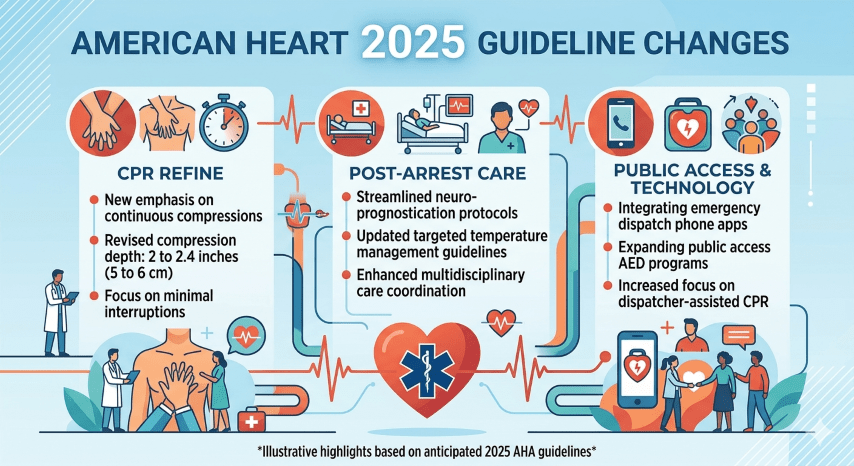
The American Heart Association (AHA) has released its newest 2025 CPR and Emergency Cardiovascular Care (ECC) Guidelines, shaping how CPR training and response is taught and practiced across the country. These updates — the first major full revision since 2020 — reflect the latest evidence and aim to improve survival from sudden cardiac arrest for all ages and in all settings.

What’s New in the AHA CPR Guidelines

1. One Unified “Chain of Survival”
The updated guidance replaces multiple versions of the Chain of Survival with one single model that applies to all cardiac arrest situations — adult, pediatric, and both in and out of hospital settings. This simplifies training and helps ensure rescuers use the same core steps regardless of the situation.

2. Expanded Choking Response Recommendations
For the first time, the AHA includes specific guidance on choking intervention for conscious adults and children — alternating five back blows with five abdominal thrusts until the airway is cleared or the person becomes unresponsive. For infants, the guidance calls for five back blows and five chest thrusts using the heel of the hand.

3. Opioid Overdose Response Included
The guidelines now contain a formal algorithm for suspected opioid overdose emergencies, including when and how to use naloxone in addition to CPR — a critical addition given the ongoing overdose crisis.

4. Lay Rescuer Training Emphasized
Evidence continues to support that bystander CPR saves lives, but less than half of cardiac arrest victims in the U.S. receive CPR from a bystander before EMS arrival. These new recommendations underscore the importance of broad community training and support for teaching CPR to people as young as 12.


Why These National Changes Matter Everywhere

CPR Outcomes Depend on Quick, Effective Action

Survival from out-of-hospital cardiac arrest remains low — around 10.5% in the U.S. — and even those who make it to the hospital may not survive to discharge. Prompt bystander CPR and early defibrillation are the most critical steps to change that.

Simplified Guidelines Mean Better Training

A unified Chain of Survival and clearer protocols make it easier for everyday people — parents, teachers, coaches, and neighbors — to remember and act without hesitation in a crisis.

Addressing Real Emergencies Beyond Classic Cardiac Arrest

Including choking response and opioid overdose protocols broadens CPR training from being a “heart-only” skill to a comprehensive emergency response tool that helps in the most common real-world life-threatening scenarios.


Takeaways for Your Community

These updated CPR guidelines aren’t just technical details for clinicians. They reflect evolving evidence about what works in emergencies, and they are designed so that everyone — not just healthcare workers — can act confidently when it matters most.

Here’s what individuals and communities should focus on:

• Learn Hands-Only CPR and AED use — it could double or triple someone’s chance of survival.
• Understand the updated choking response techniques for adults, kids, and infants.
• Be prepared to recognize and respond to opioid-related breathing emergencies.
• Encourage friends, family, and coworkers to get certified — especially young people.

👉 Get certified with In-Pulse CPR’s hands-on CPR + AED courses to train with the latest AHA guidance and be ready to help in real emergencies.
Because preparedness isn’t just recommended — it saves lives.

Ordinary Morning, Extraordinary Heroism — Strangers Perform CPR and Save a Life in Rochester

In Rochester, Minnesota, an ordinary morning turned into an extraordinary lifesaving moment when a group of strangers sprang into action to help a man in sudden medical distress — a real-world reminder of why CPR training matters for everyone.

On October 6, 2025, a Rochester resident suddenly became unresponsive while sitting inside his vehicle on Bandel Road NW. Witnesses reported that the man was unconscious and possibly experiencing cardiac arrest. In that critical moment — before professional help could arrive — a bystander named Tricia Sommers recognized the emergency and began performing CPR to help keep blood circulation going until paramedics could take over.

Thanks to the split-second decision by Sommers and others who helped or supported her decision to act, the man was transported to St. Marys Hospital for further treatment, where he awaited heart stenting procedures.

What Happened in Rochester?

This event was not a staged demonstration or high-tech rescue — it was a real cardiac emergency that happened in a neighborhood most days don’t see headlines. When faced with someone who was unconscious and not breathing normally, a group of ordinary people became extraordinary by stepping in and starting CPR right away.

According to emergency medical experts and the American Heart Association, immediate CPR can double or even triple a person’s chance of survival following sudden cardiac arrest, especially when started before EMS arrives. Early high-quality chest compressions help keep oxygenated blood flowing to vital organs — particularly the brain — during those first crucial minutes.

Why This Rochester Story Matters for Minnesota

1. Cardiac Arrest Can Happen Anywhere

Whether you’re driving to work, shopping, or sitting in your car, cardiac emergencies don’t wait for help to show up. But trained bystanders can be the help.

2. Bystander Action Saves Lives

In this case in Rochester, the decision to act quickly with CPR likely made the critical difference between life and loss.

3. Preparedness Beats Panic

Knowing the basic steps of CPR — checking responsiveness, calling 911, and starting compressions — empowers everyday Minnesota residents to respond confidently in emergencies.

CPR in Minnesota: A Community Priority

Across the state, efforts to improve outcomes from cardiac arrest increasingly emphasize public training and accessibility of lifesaving skills. Initiatives like Take Heart Anoka County and other community CPR/AED education programs show there’s growing momentum to equip more Minnesotans with the tools and confidence to act.

What You Can Do

Minnesota residents can take action right now to become lifesavers in their own communities:

  • Get Hands-On CPR + AED Training
    Classroom or blended certified courses build muscle memory and confidence — far beyond just watching videos.
  • Learn the Chain of Survival
    Knowing how to call 911, start compressions, and use an AED fast is essential.
  • Encourage Community AED Access
    More defibrillators in public places mean more chances to make a lifesaving shock available when it matters most.

Be Ready to Help — Be the Difference

This Rochester save is a powerful reminder: You don’t need to be a medical professional to make a lifesaving difference. With proper CPR training, ordinary people can save real lives.

👉 Sign up for an In-Pulse CPR course in Minnesota today and be prepared to act when every second counts.

Minnesota AED Installed Days Before Saves Life at Pickleball Court

In Eden Prairie, Minnesota, a lifesaving moment unfolded at a community pickleball court — and it hinged on both preparation and action. On October 7, 2025, Rory Bakke collapsed suddenly during a game at the Miller Park pickleball courts. Thanks to a newly installed AED (Automated External Defibrillator) and prompt response from his girlfriend and bystanders, Rory’s life was saved.

The AED had been mounted just days before the incident — a decision made after community members raised awareness for cardiac emergency preparedness. When Rory went into cardiac arrest and fell unconscious, Sunny Saengdara didn’t hesitate. By the time paramedics arrived, she had already used the AED and CPR efforts were underway — helping restore Rory’s pulse and stabilizing him for transport to the hospital.

His survival highlights two critical elements of real-world cardiac arrest response:

1. AED Access Saves Lives
Early defibrillation dramatically increases survival chances during cardiac arrest, especially when used within minutes of collapse.

2. Bystander Action Matters
Sunny and other witnesses stepped in immediately — a reminder that having trained responders nearby can make all the difference.

This Minnesota story is more than a headline. It’s a local demonstration that preparation, awareness, and action save lives — whether on a sports court, in a mall, or at home.